Saturday, October 01, 2011

GTMO Gardening


My primary goal is to grow tomatoes. However, this time of year the ground temperature is too warm. In an effort to trick mother nature I'm shading the ground, and pumping cool water around my tomato plants.

Notice that the basil and cilantro are doing well, but tomatoes not-so-much.


My container plants have the same problem; too warm here this time of year.


Tropical plants, like this pineapple, are doing well.


I was hoping for fresh bananna's, but this seems to be a plantain plant. I'll take what I can get.


We enjoy fresh Mango's, when in season.


I've never seen a Banyon tree before coming to GTMO. These can be freeky and huge.


I'll probably have to wait for cooler weather before I can successfully grow tomatoes again. Meanwhile, I'll enjoy the beach.

John


Wednesday, October 20, 2010

Range Anxiety

As I think about what I’ll look for in my first electric car, one of my primary concerns is range. I didn’t invent the term “Range Anxiety”, but that is precisely what I am feeling. I think about the driving I’ll do, and how I’ll be limited by lack of range. When I want to visit my daughter, 95 miles away, I realize that the round-trip will not be possible with most electric cars in my price range. I know that charging stations will be popping up everywhere, but will I find one when I need one? When I get to one, will I have to wait in line? My “Range Anxiety” is likely to be replaced by “Charging Station Anxiety”, once I actually own an electric car.

It seems that GM considered “Range Anxiety” when they decided to put a gas-engine in their Volt. If it delivers as promised, it will be an excellent choice. On the other hand Nisson just doesn’t seem to get it. Their Leif car not only doesn’t have a gas-engine, it also requires a special charger, and that charger is not portable. Trips to visit my daughter in a Leaf are out. I won’t be able to recharge for the trip back home. The Leif would be great for my daily work commute, but I would have to own a second car for longer trips.

The Plug-in Prius, expected to be available in 2012, will be a wise choice for some. For those who drive less than 13 miles per day, as many commuters do, it will do that without using a drop of gas. After the initial 13 miles, it becomes an efficient gas-powered car, getting up to 50 miles per gallon. Like the Volt, there will be no range anxiety with a Plug-in Prius. And with it's smaller battery pack, the Plug-in Prius should cost less than the Volt. The Plug-in Prius can be charged in 3 hours or less, using a standard 110 volt outlet. For those who can charge while at work, electric-only round-trip (work commute) range will be 26 miles.

It’s not hard to predict how we’ll drive in the future. The Volt and the Plug-in Prius will be excellent cross-over cars, until technology catches up and solves the range problem with the early electric-only cars. It’s bound to happen. With tens of thousands of batteries in production, prices will drop and performance will improve. This is precisely what has happened with televisions, computers, and just about everything else in mass-production. And keep in mind that the total cost of ownership includes more than just the purchase price. Televisions, for example, once had tubes in them. Those TV’s quickly disappeared when they became too expensive to maintain. And like televisions, VCR’s were once large and expensive. Now we get the same results with a smaller and much less expensive device. Electric cars will be much less expensive to fuel, repair and maintain.

Nisson is not the only car company that “doesn’t get it”. Many manufacturers think we’ll settle for “Clown Cars”. (That’s what they look like to me). Not only do I not want to be seen in such a car, I wouldn’t dare drive it on an expressway. I would be better off with a golf cart for neighborhood-only driving.

Making safe electric cars will be a big challenge. A lighter car will deliver greater range per charge, but will probably be less safe in an accident than a heavier car. On the other hand, I can’t imagine anything more dangerous than sitting a few feet from 15 gallons of gasoline and a hot engine. Battery-powered cars will have devices designed to cut power in the event of a crash.

How much will it cost to drive a Plug-in Prius?

According to the Plug-in Prius webpage, it will take 1000 watts for 3 hours (3kwh) to charge the Plug-in Prius, and you’ll be able to drive 13 miles on a full charge.

If electricity costs 10 cents per kwh, 13 miles of driving in a Plug-in Prius will cost 30 cents in electricity.

If gasoline costs $3.00 per gallon, and you drive a car that gets 26 miles per gallon, it will cost $1.50 in gas to drive 13 miles.

In some locations, electric rates vary, depending on the time of day. In fact, I pay less than 3 cents per kwh late at night. At that rate, my cost to drive a Plug-in Prius, for the first 13 miles, will be less than 9 cents. Now 13 miles doesn’t sound like a lot, but my work commute (before I moved to GTMO) was about 13 miles. With the Plug-in Prius, I will trade $30.00 in gasoline for $1.80 in electricity each month. After the first 13 miles, Plug-in Prius gas range is expected to be about 50mpg, or about twice as good as the car I currently drive.

Someday soon, owning a gas-powered car will be like owning a television from the 60’s. Unless it’s a “Show Car”, it just won’t make sense. It might be fun to keep one around to tinker with, but it will not be practical as a source of transportation. Some will have trouble leaving the memories behind, like the sound of a well-tuned V8 engine, but I can live without it. I can live without the grease, pollution, and noise. If I have to have high-performance, I’ll save up for a Tesla Roadster.

Range anxiety is likely to be a household term soon, but we’ll quickly forget about that, just as we’ve forgotten about all of those VCR’s that constantly flashed 12:00. The Volt and the Plug-in Prius will soon be thought of as a sensible forms of transportation, but years from now we’ll think of them as quaint.

John

Monday, May 24, 2010

Just Say No to Oil

I could jump on the bandwagon and blame BP, the president, or congress for the recent disaster in the Gulf, but I won’t. I think we need to look at ourselves instead. As long as we keep using oil, someone will drill for it and accidents will happen. If we stop using oil there would be no need for off-shore drilling.

I do understand that we’re not going to stop using oil overnight. Paul Roberts, author of the book “The End of Oil” claims that the U.S. is decades away from shedding its reliance on oil. I disagree. Cutting back would be a good start, and that’s something we can begin to do today. We can start by avoiding unnecessary driving. Motor-bikes, scooters, or even bicycles are practical alternatives to cars for some, while others can use mass-transit. When it’s time to replace the vehicle (that you absolutely can’t live without), consider an efficient one, perhaps a hybrid. Plug-in-electric vehicles will soon be available, so plan accordingly. These are only a few things we can all do. With a little effort, we could reduce oil consumption by 50% in one year. Imagine how we would all benefit from that!

If you’re reading this, you are probably someone who is concerned about the envoronment. That’s great, but we need to bring others on-board. We need to lead by example. Leading by example is far more effective than ranting and raving like an environmentalist kook. The car you drive speaks volumes about your intentions. And while few will notice your energy-efficient lighting or appliances, solar panels on your roof would be hard to ignore. Start small if you must, at least replacing some of the fossil fuel you would otherwise use in your home with electricity from solar panels. Others will follow your lead eventually, and we’ll all benefit.

Sadly, many people still think that conservation, and implementing renewable energy solutions, will somehow result in a lower quality of life. This is simply not true, and we need to spread the word. When done right, quality of life can be enhanced. CFL or LED lighting provide the same amount of light as incandescent bulbs, while reducing electricity use significantly. Imagine that; you’ll be doing something positive for the environment, and enhancing your quality of life via lower electric bills.

And speaking of enhancing your quality of life; a plug-in-hybrid car can be recharged at night, when electric rates are low. You might be able to replace the four dollars a day you are currently spending for gasoline with less than one dollar for electricity. For more about this, click here: http://solarjohn.blogspot.com/2007/12/driving-phev-is-like-buying-gasoline-at.html

Everything we currently do that involves oil can be done another way, and often in a much better way. The transition to renewable energy will open up new career opportunities. Technically savvy folks will find interesting work in energy production, construction, service, and transportation. Those who are the quickest to accept post-oil technologies will be the most successful.

We can’t just stop using oil overnight, but the idea of waiting decades is a concept that we shouldn’t accept. When the oil spill in the gulf becomes old news, we must remain committed to cutting back. Each time we purchase a vehicle, an appliance, or even a light bulb, we should shop with energy-efficiency as our top priority.

If you need another reason to implement and promote alternative energy, perhaps the best one is that not a single soldier will need to give his life to keep renewable energy flowing.

Please, just say no to oil.

John

Wednesday, March 17, 2010

Solar Panels at Gitmo


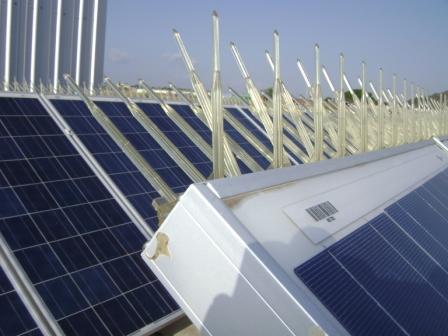
Does anyone know what the plastic rods on top of the solar panels are for? My guess is that their purpose is to keep birds from perching there.


Gitmo has windmills too...

Saturday, November 21, 2009

GITMO

My renewable energy projects have been placed on hold, for now, because I'm on assignment at GITMO. Fortunately, my off-grid system is running on automatic pilot. Too bad I didn't make provisions for monitoring it via the Internet. For anyone who might be interested, here's a little information from where I am at the present time. Check back later for my report on renewable energy at GITMO.

GITMO is an incredibly interesting place to explore. There are some great bike trails. Here's a view of a section of the base from up on a hill. The second picture is a section of Caribbean Shoreline. The cliffs are acutally rock and fossilized corral. I've never seen anything like it. The final picture is of the base Hospital.


Tuesday, August 04, 2009

The Smart Grid and You

If you’re reading this you’re probably someone who takes responsibility for your own future, instead of waiting for the government or someone else to do things for you. Perhaps you’ve already installed solar panels, instead of waiting for substantial rebates or subsidies. You don’t get excited when you hear about a breakthrough, and you’re not waiting for a dramatic price reduction of solar panels. You may not be able to justify the high cost based on the electricity your system produces, but you have no regrets. You have a system that provides an emergency source of electricity to serve when the grid fails, and you have some protection from the inevitable rate increases. And, should you experience a total melt-down of society, you’re better equipped to live a self-sufficient lifestyle than those who don’t have these systems.

As content as you might be with your own efforts, it’s good to see environmentally-beneficial government-supported projects when they do occur. The Smart Grid is a project that recently received significant funding from the Obama Administration, and those of us who already have solar- or wind-power systems will benefit to a greater extent than those who don’t.

The Smart Grid, when implemented, will be a modernization of the current electrical generation and distribution system. The Smart Grid will be an automated network, with a two-way flow of electricity and information. Extensive monitoring will result in a much more efficient system, benefiting electricity providers, as well as consumers. Providers will be better equipped to reduce generation and transmission costs, and consumers will be better prepared to make decisions affecting their use of electricity and control cost. The Smart Grid will have a positive environmental benefit as well.

Monitoring and control will extend beyond the generation and transmission infrastructure. In-home monitoring and control is another characteristic of the Smart Grid. Consumers will have real-time cost information, helping them to manage electricity use in order to save money. Additionally, smart appliances in the home will use this information to automatically reduce energy usage. Use of the cost-saving features built into smart appliances will be voluntary, not mandatory. Users will have the ability to override these cost-saving features if they so desire.

Other characteristics of the Smart Grid are its ability to accept power from solar and wind systems, and to utilize energy storage devices. This should be particularly interesting to those who have solar or wind systems, and to those who plan to purchase an electric vehicle. You may be an electricity provider someday, and you’ll be paid for it.

While some will simply ignore the available information concerning the cost of electricity, others will minimize their use when the cost is high. Doing laundry, running the dishwasher, and vacuuming are all chores that can be done when rates are low. If you have a solar electric system or a wind turbine, you have an additional option; use energy from your system when grid-supplied electricity is expensive, and use grid-supplied electricity when the cost is low. That, of course, is intuitive and many are already doing that. However, there are other strategies that may result in additional savings. For example; consider charging batteries when electric rates are low, and use the stored energy when rates are high. The battery charger could be controlled by a timer, set to be powered-up when rates are low, and to switch off when rates are high. Better yet, the battery charger could be switched on and off via a “Smart Controller”. A Smart Controller would be a device that can switch power to an outlet on and off based on preset electricity rate thresholds. I’m not aware that such a device exists, but it soon will. You’ll need a battery charger, (like the one described here), that will not overcharge your batteries.

Those who’ll benefit most from the Smart Grid will be, no doubt, those who drive Plug-in-Electric-Vehicles (PHEV’s). Most will be charged at night, when electric rates are low. Consider for a moment that you’ll pay about twenty cents per kwh for electricity during periods of peak demand, and less than two cents per kwh when demand is low. (These figures are based on my actual cost for electricity as a participant in a program offered by my provider). While your cost to top off the battery during the day might be as much as 3 dollars, the cost at night could be less than 30 cents. Replacing gasoline with electricity for transportation could result in a savings of $1000.00 each year. At 3 dollars per gallon, cutting gasoline use by one gallon a day would accomplish that. Those who need to charge their PHEV’s during the day, night-shift workers for example, would benefit by installing a PV system.

Some PHEV’s will be connected to the grid during the day, returning excess power to the grid during periods of peak demand. This concept, known as Vehicle-to-Grid (V2G) technology, is another example of an innovation made possible by a Smart Grid implementation that will benefit providers and users of electricity. Theoretically, you could earn money by connecting a PHEV to the grid. If you recharge at night when rates are low, and return power to the grid when rates are high, you might find that the power company owes you money at the end of the month. You’ll not only eliminate your use of gasoline, you could fuel your car at no cost at all. Your actual results will depend on the number of miles you drive each day.

“Ask not what the grid
can do for you. Ask what you can do for the grid – and
prepare to get paid for it!”


Your contribution to the grid, as small as it might be, will be an important part of the Smart Grid. Solar, wind, and V2G systems will increase the number of electricity providers dramatically. The result will be a broad distribution system that is less vulnerable to natural disasters and terrorist attacks. Utilities will have better control of resources, reducing the need to add power plants simply to meet peak demands.

Whether you’re an electricity provider, consumer, or both, you need to be able to measure the flow of electricity to be able to control it. The Smart Grid will provide that capability, and pave the way for the development of tools to better manage electricity. Pilot projects have already shown that Smart Grid technology not only enhances electric grid reliability and reduces outages, but also creates smaller electricity bills for consumers and could alleviate the need for additional infrastructure. The Smart Grid connects consumers to the grid in a way that is beneficial to both. This is the dawn of some pretty interesting innovations.

John

Wednesday, July 29, 2009

Survival in the 21st Century (Part 2)

Recently I asked you to consider what would happen to you and your family in the event of a pandemic, natural disaster, or major terrorist attack. I ask you to imagine a scenario in which you find empty grocery store shelves, no running water or electricity, and no natural gas service. I find that most people have given some thought to this, and have made preparations, at least for the first few days following an emergency. Putting together an emergency kit is easy. However, preparations for long-term survival are not so easy. To make matters worse, people tend to believe that they’re ready, when in fact they are not. A plan, by itself, is not enough. It’s easy to say “I’ll plant a garden”, but do you have the tools and skills? Could you install a solar photovoltaic (PV) system and make it work? Do you have a plan to keep your home warm if you find yourself without utility-supplied heating fuel? Remember, in an emergency many of your neighbors will be looking for the same equipment and supplies that you’ll be looking for. The time to prepare is BEFORE an emergency.

If you have no previous gardening experience you’re likely to be disappointed with the results of your first attempt. In fact, it may take several seasons to become a good gardener. Even experienced gardeners continue to learn from season to season. Are you confident that you can grow a crop big enough to get you and your family through the winter? Do you have seeds? Can you keep insects and pests from ruining your crops? If you do manage to grow something, will you be able to preserve it for later consumption? Do you have the items needed for canning and preserving?

Solar panels, batteries, and the other components needed to build a solar electric system might be hard to find in an emergency. And, even if you can find the items you need, will you be able to build a system and use it efficiently? Unless you have previous experience, it’s unlikely that you’ll get the most out of this equipment. Beginner’s mistakes might result in damaged equipment and a system malfunction just when it’s needed the most.

I suspect that most of us are woefully unprepared for long-term survival and sustainable living, but fortunately we can do something about that. Here are a few suggestions:

Learn how to grow things now, don’t wait until spring. You’ll find plenty of information on-line. Consider plants that you can grow indoors, with limited space requirements. These might include herbs, wheat-grass, and dwarf tomato plants. Start a compost pile/bin. You’ll use the finished compost (humus), later to improve the soil. Plan your outdoor garden, and begin working the soil early in the spring. Save seeds from your successful crops. Saved seeds, from crops grown in your own backyard, will be better suited to your area than those bought from an out-of-the-area supplier. By the end of the season you’ll have plenty of ideas for doing things better next year.

If you have an acre or more of land, you might consider growing your own heating fuel. You can grow enough corn to heat your home for an entire winter on just one acre of land, but land alone is not enough. You’ll need equipment for planting, growing, and processing the corn as well as a way to securely store it for later use. You’ll have to protect your crop from insects and animals. This can be a monumental task, and perhaps overwhelming without the appropriate equipment. You might consider heating your home with wood if you can count on an abundant supply. Whichever method you choose, learn to use your stove or alternative heater efficiently and safely, and stock up on the appropriate fuel. Keep in mind that with an ordinary fireplace the heat goes up the chimney. The only warm spot in the home is directly in front of the fireplace. You’ll need a better strategy than that. If you’ve installed a heat exchanger, and if you have a dependable supply of electricity to power the blower, you’re in business.

Install and use an off-grid solar photovoltaic (PV) system. Monitor daily electricity production, and use. Shut down service from the power grid once in a while to check your system’s performance in a simulated grid power failure. You’ll learn from these simulations, you’ll adjust, and you’ll be better prepared for an actual emergency. Since your system probably won’t be big enough to supply all of your household needs for electricity, you’ll find ways to conserve. You’ll change to power-sipping compact fluorescent bulbs (cfl’s), for example. As you become more and more self-sufficient, you’ll be cutting your utility bills at the same time, a win-win situation.

Sustainable living skills need to be learned and practiced BEFORE an emergency. Unless you prepare in advance you probably won’t have the equipment, supplies, and skills needed for survival in the event of an emergency. Remember, you’re not preparing for the end of the world, you’re preparing for the future of the unknown. I hope you’ll take advantage of the information provided in this blog’s archives as you prepare. As always, I look forward to your comments and suggestions as I become more self-sufficient.

John

Thursday, July 23, 2009

Survival in the 21st Century

What would happen to you and your family if a pandemic, natural disaster or a major terrorist attack were to occur? Imagine empty grocery store shelves, no gasoline, no running water, no electricity, and no natural gas service. You may have enough food and water to last for a few days, but what do you do after that?

You can live 3 minutes without air.
You can live 3 days without water.
You can live 3 weeks without food.


A good survival plan should begin with preparations to deal with an emergency within the first few minutes, and end with strategies for long-term survival.

In the event of an explosion, fire, or crash you may need to deal with broken glass and sharp metal objects and hot objects. Imagine how handy gloves would be. You should also be prepared to handle physical injuries you may sustain, as well as those of family members and others nearby. A knife is a necessity, as is a well-equipped first aid kit.

Survival preparations for the first few days after the emergency should include a supply of food and water, of course, but you’ll also need shelter and perhaps the ability to stay warm and dry. Help may be slow in coming in the event of a large-scale disaster. Many New Orleans residents learned this the hard way after Hurricane Katrina.

Survival becomes something else after the first few days. Your need for water and food is an ongoing one, and your stockpile may be running low. Perhaps you’ve banded together with neighbors, and pooled your resources. That’s a good thing. Each member of the group has his or her own unique talents, many of which can help to ensure the survival of your group. Skills such as hunting, trapping, and fishing will certainly come in handy, as will the ability to identify edible plants.

Whether you live in a city, or in a rural area, the importance of urban gardening and small-scale farming cannot be overemphasized. And, of course, you’ll need to know how to preserve and store food. Improperly stored food may rot, or be ruined by insects or rodents. It should be obvious that these skills need to be learned BEFORE an emergency. The people most likely to survive are those who’ve already incorporated elements of sustainable living into their everyday lives. Some have moved out of heavily populated areas, realizing that in the event of a disaster it will be difficult to get food when a million of their neighbors are also looking for it. They’re learning and practicing the skills that their great grandparents knew well. Some are making their own electricity with solar panels, windmills, and micro-hydro systems. Life in a rural area presents an abundance of opportunities for sustainable living, many of which are not available in the city.

Electricity may seem like a luxury, and some may believe that solar panels, windmills, and micro-hydro systems shouldn’t be included in a survival discussion. I disagree. Electricity can be an important aspect of survival in several ways. When used to power a refrigerator or freezer, electricity becomes a big part of a food preservation strategy. Additionally, refrigeration is often needed to keep medications from spoiling. Having electricity means that you’ll have good lighting, an important security consideration, and it helps to prevent accidental injuries around the home. Without electricity, you might have to boil water over a fire to make it safe for drinking. A renewable supply of electricity can keep a radio or TV operating, providing critical information as well as entertainment. When you think of all the electrically-operated appliances that you would otherwise have to do without, it’s obvious that electricity can make life comfortable in an otherwise unbearable situation.

Some will have you believe that you’ll need to spend tens of thousands of dollars for a practical solar electric system, but that’s simply not true. A system to meet your basic needs can be built for under $1000.00. You won’t have central air-conditioning with a small system, but you will have lighting, communications, and perhaps a limited amount of electricity for cooking and refrigeration. In the absence of grid power, you’ll be thankful for the small amount of electricity your system provides. You’ll learn techniques for getting by with less. A chest freezer, for example, can meet your refrigeration needs with much less energy consumption than a refrigerator.

You may think that these gloom-and-doom scenarios are unrealistic and choose to do nothing, but if you believe that that things could get ugly you should prepare as soon as you can. If you wait until things get bad, it will be too late. You’ll be forced to use the resources you have available, not the systems you planned to install someday. Surviving a disaster will be a challenge, so being in good physical condition is important. Don’t abuse alcohol, tobacco, or other drugs. You may have the additional task of caring for very young or very old family members. Make regular exercise a part of your plan. Don’t be overwhelmed, the important thing is to get started. Eat healthy and get plenty of rest.

“The thing about being a survivalist kook and stockpiling gold, guns, and food is that there’s no downside. Even if you’re wrong, you’ve still got gold, guns, and food.” W.C. Verson

Being a “survivalist” today means more than simply providing for your own comfort. Today, survival of the planet is an important consideration as well. In the absence of a healthy planet, even the most carefully laid out personal plans will be of no value.

About 50% of the electricity produced in the United States comes from coal-fired power plants. Mining, transporting, and burning coal has terrible environmental consequences. Additionally, oil reserves are running low (peak oil). It should be obvious that we’re on the brink of a radical lifestyle change. The good news is that we can do a lot, with very little sacrifice. Our lifestyles include a lot of waste, and therefore we have numerous opportunities to make changes that will benefit not only ourselves, but all of mankind and the planet.

By incorporating elements of self-sufficient living into your lifestyle, you’ll benefit from a better quality of food, more exercise, and better air quality. Anyone who’s ever compared a store-bought tomato to one grown in a backyard garden knows what I mean. Tomatoes that have to be shipped a long distance are picked green, and “gassed” to turn them red by the time they show up in the supermarket. They’re rock-hard, and have little flavor. I can only guess that the nutritional and cancer-fighting properties are not what they should be either. And it’s wise to remember that the recent salmonella outbreak linked to tomatoes was a result of industrial agriculture. Shipping fewer vegetables not only means better food, it also means fewer trucks on the road, which reduces fossil fuel use and improves air quality.

In the words of Charles Darwin, "It is not the strongest of the species that survives, nor the most intelligent, but the one most responsive to change.” Problems related to global warming and the decline of oil are among the most significant changes this generation will face. Many believe that global warming is responsible for climate change, including extreme weather, such as storms of greater intensity. Some believe that global warming is a natural phenomenon, while others believe that it is caused by our actions. Perhaps it’s some of both. Regardless of the cause, our response needs to be a thoughtful plan, not simply a knee-jerk reaction to the latest crisis.

Someday we’ll have a leader who will actually work with us to solve problems, instead of telling us we’re “addicted to oil”, but for now we’re just going to have to rely on our own efforts. Mass acceptance of renewable energy systems by the general public will show our elected officials, and the rest of the world, that we want to do the right thing. We can do it. We should do it. Future generations will appreciate our efforts.

John

Sunday, June 14, 2009

OAR, SAIC, and The Green Dream

Being so involved with recycling, conservation, and renewable energy in my personal life, I was happy to volunteer to assist in a recycling booth last week. Rock Band OAR and corporate sponsor SAIC teamed up recently to encourage recycling and conservation. OAR calls this their “Green Dream Tour.”

For my efforts I received a souvenir T-shirt, an opportunity to meet the band, and free admission to the concert. More importantly, I had the opportunity to spread the word about the importance of recycling and conservation. The band, my co-volunteers, and everyone else involved was fun to work with. This was an enjoyable evening. Here are a few pictures…..


The band, and SAIC volunteers.


The fabulous Fox Theater in St. Louis.


Setting up.


OAR on stage.


Great show! The packed house really seemed to enjoy it.

John

Saturday, May 30, 2009

My Off-Grid Photovoltaic System and This Blog

You might have noticed a decline in the number of posts to this blog since the first of this year. The decline is primarily due to the fact that my off-grid system hasn’t changed much over the past 6 months. I’ve slowed down because I now pretty much have what I want; a system that can meet my basic needs for electricity during a grid power failure, and one that provides enough energy to significantly lower my electric bill. I’ve also added automation to my system, providing additional protection for my batteries while optimizing power output.

I’ll probably never have enough PV-provided electricity to meet all of my needs, but I can get by pretty comfortably most of the time with the system I now have. It’s important to mention that my need for electricity during a grid-power failure varies with each season. Lengthy periods of cold weather provide the greatest challenge. In addition to the electricity needed for lighting, refrigeration, cooking, and communications, I’ll need electricity to keep my home warm. I can easily use up all of my stored energy during extended periods of cloud cover. With that in mind, I plan to add another PV panel this year, and one or more next year. Other than that, I have no other significant upgrade plans. I’ll maintain this slow but steady progress unless I see a dramatic increase in the cost of grid-supplied electricity, or a dramatic decrease in the cost of solar panels. I hope to drive an electric car within the next two years, and I would love to power it with solar. This is not practical now, with PV panels costing $5.00 per watt.

Here is an overview of my system:

Type: Off-grid
PV: 7 X 85, or 595 watts
Batteries: GC2’s wired for 12 volts, 900ah.
Spare Battery Bank: Marine Deep Cycle, 420ah.
Controller: TriStar 60 with meter and remote temperature probe
Inverter: Exeltec 12-volt, 1100-watt pure sine wave
Automation: Morningstar Relay Driver programmed to enable/disable the inverter and an Iota Transfer Switch

When I started installing solar PV, my primary goal was to become more self-sufficient, especially in the event of a major disaster. From time to time I need to remind myself that water and food are much more important than electric lights in the event of such a disaster. That’s why you’ll find so many articles about growing and preserving food in this blogs archives. You’ll also find articles concerning alternative heating, another necessity for surviving in the event of a loss of natural gas and grid-supplied electricity.

I hope that you’ll browse my archives now and then for ideas, and comment. Let’s learn from each other.

John

Friday, April 17, 2009

Grow Your Own Medicine

Last week I provided strategies for growing your own vegetables. If you choose to do that you’ll not only be eating fresher and healthier food, you’ll avoid harmful chemicals and pesticides. This is more important today than ever before for a couple of reasons: Much of the food we consume comes from bioengineered plants, and those plants are much more dependent upon chemicals than the plants they’ve replaced. As a result, we’re exposed to chemicals to a much greater extent than we were in the past. Additionally, much of the food we consume today comes from foreign suppliers, including China, where regulations and inspections are not as thorough as they should be. And unfortunately, only a small percentage of food imports are inspected as they enter the United States.

While your garden might include great-tasting tomatoes, peppers, lettuce, and so on, you might also consider growing medicinal crops. Many people have already switched to alternative medicine due to the high cost of conventional medicine, while others choose alternatives when conventional medicine fails. The possibility of a dramatic cure, improved quality of life, and increased life expectancy are a few more reasons some people choose alternatives.

Of the medicinal crops that you might consider, Bitter Melon is one that can be used to treat a variety of disorders, including diabetes and HIV. Bitter Melon is a green, cucumber shaped fruit, with gourd-like bumps. While all parts of the plant have been used, the fruit is the safest and most prevalent part of the plant used medicinally. Rich in iron, bitter melon has twice the beta carotene of broccoli, twice the calcium of spinach, twice the potassium of bananas, and contains vitamins C and B 1 to 3, phosphorus and good dietary fiber. It is believed to be good for the liver and has been proven by western scientists to contain insulin, act as an anti-tumor agent, and inhibit HIV-1 infection. Multiple clinical studies have clearly established the role of Bitter Melon in people with diabetes. Practitioners of Chinese medicine have been using it for hundreds of years with good results. In the Philippines, Bitter Melon (known as Ampalaya) is also used to treat infections, fevers, and rheumatism.


Bitter Melon contains an insulin-like principle, known as plant-insulin, which has been found effective in lowering blood and urine sugar levels. The diabetic should take the juice of about four or five fruits every morning on an empty stomach. Bitter Melon seeds can be added to food in a powdered form. Fresh juice from the leaves of Bitter Melon can be used to treat a variety of disorders. To prepare a Bitter Melon extract:

Wash and finely chop the leaves.
Add 6 tablespoons of the chopped leaves in 2 glasses of water.
Boil it for 15 min. in an uncovered pot.
Cool down and strain.
Drink 1/3 cup of it 3x a day.

Although research supports the use of Bitter Melon as a treatment for many conditions, it is not clear what dose is safe and effective. Bitter Melon should be used cautiously, with close monitoring by your health care provider.

Need seeds? Let me know.

Link:

Check out Garden Web, Asian Vegetables section, for information about growing Bitter Melon. As you search for additional information, keep in mind that Bitter Melon is also known as Ampalaya and Bitter Gourd.

http://forums.gardenweb.com/forums/asianveg/

Other Links:

http://bittermelon.org/

http://holisticonline.com/Herbal-Med/_Herbs/h31.htm

http://www.sciencedaily.com/releases/2008/03/080327091255.htm

John

Thursday, April 09, 2009

Strategies for Eating Healthy

“Eat your vegetables and you’ll grow up strong and healthy”, we were told as children, but things are different today. Today, much of our food comes from overseas, and hardly a week goes by without news of a tainted food product, usually from China. China’s agricultural exports to the United States surged last year, and I expect to see many more disturbing articles in the future. And sadly, we can’t rely on product labels for healthy eating. Some farmers in China are taking advantage of confusing rules to falsely label food. Chinese authorities have vowed to fix the problems, but the disasters keep coming.

Since the United States subjects only a small fraction of its food imports to inspection, it’s up to each of us to see that our families are eating healthy. With these things in mind, here are my suggestions:

1. Grow your own food. Preserve some of it for off-season consumption.

Canning, freezing, and storing food in a root-cellar are a few of strategies you might consider.

2. Buy locally-grown organic food when it is in season.

You can often find bargains, and will benefit by preserving some of those crops for off-season consumption.

3. Learn to grow food in the winter.


If you have a sunroom, or even a south-facing windowsill, you can grow your own vegetables and herbs year-round. Since full-sized plants might present a space problem, investigate dwarf plants instead. Red Robin, for example, is a tomato plant that grows to a height of only 16 inches, and produces bunches of great-tasting cherry tomatoes.


If you decide to grow your own vegetables indoors you’ll need to provide the right conditions for plant growth. This can be a little tricky, since each type of plant will have somewhat different needs. The small plant stand shown here includes a heater, and a shop light with fluorescent tubes. Upper and lower levels contribute to an efficient use of space.

Here are some things you'll need to know in order to grow dwarf tomato plants:

Temperature:

Seeds germinate best at about 70 to 80 degrees F.

The ideal temperature for new seedlings is about 60 to 65 degrees.

Mature plants need warmer temperatures for setting fruit (70 to 85 degrees).

Plants can tolerate night-time temperature drops, but avoid going below 50 degrees.

Avoid temperatures above 90 degrees. Extreme temperature variations will affect production.

Light:

Provide at least 6 hours of sunlight per day for seeds that have sprouted. More sunlight, up to 16 hours per day, will produce better tasting fruit. If potted plants will be getting light from a closed window, place the plants as close to the window as possible. If necessary, supplement natural sunlight with the light from a cool-white fluorescent bulb. For this to be effective, the light must be placed within a few inches of the top of the plants.

Soil:

Use a good quality seed starting soil. Repot, when necessary, in a good quality potting soil. Provide good drainage and avoid compaction of the soil. The bottom of the pot should have holes to allow excess water to drain. Red Robin will do well in an 8” diameter container, but you can try a smaller one if your space is limited. If the plant cannot support the weight of the fruit, stake it with a ¼” stick or dowel. Tie the main stem to the stake with cotton or nylon cloth. Do not use string or thread.

Water and feeding:

Use an organic fertilizer formulated specifically for tomatoes according to the instructions on the package. Don’t use fertilizer heavy in Nitrogen. That will result in lush plants with very little fruit. Occasionally, use water with 1 tablespoon per gallon Epsom salts. This provides additional magnesium for the plants.

Avoid watering from the top. Too much dampness at the base of the plant can result in a fungal problem. It is best to water from the bottom, allowing the potting soil to soak it up. Do not add more water than can be soaked up by the plant.

Air:

Plants breathe. Use a fan to circulate air through the leaves or open a window (weather permitting). A strong breeze not only helps with respiration, it helps stalks and stems grow sturdy. Remember that roots need air also. Avoid watering too much, and soil compaction.

Pollination:

Once a day, shake or tap plants that have produced flowers. This allows the plants to pollinate, and therefore, set fruit. A gentle breeze also helps with pollination.

Saving Seeds:

Cut a ripe tomato in half, scoop out the seeds and pulp, and place in a jar with a little water and cover with plastic wrap. Stir the seeds a few times a day for the next 2 or 3 days. During the fermentation process, the good seeds will separate from the gelatinous covering and sink to the bottom after which time you can pour off the liquid and junk. Rinse the seeds with cool, clean water. A fine mesh strainer or even coffee filters work. Dry seeds thoroughly before storing.

Additional Information:

Gardening, indoor or outdoor, not only reduces your exposure to harmful pesticides, you’ll enjoy fresher and tastier food and cut your grocery bill. Exercise and fresh-air are a couple more benefits you’ll experience as a gardener. But, there’s more! Have you ever considered growing medicinal crops? Check back next week for more information on that subject.

Links:

Here is a good source of seeds and information:

http://www.containerseeds.com/index.html

Garden Web is one of the best informational sites I’ve found:

http://www.gardenweb.com

Washington Post article about tainted milk from China:

http://www.washingtonpost.com/wp-dyn/content/article/2007/04/24/AR2007042402539_pf.html

More bad news from China:

http://www.manufacturing.net/News-Pesticides-Found-In-Frozen-Beans-From-China.aspx?menuid

John

Wednesday, April 01, 2009

GeoBulb (LED) vs CFL (Compact Fluorescent)

I’m always on the lookout for products that reduce my carbon footprint while saving me money, and I don’t mind paying a premium price for a product if I can expect to benefit in the long run. At first glance the C.Crane GeoBulb seems to be such a product, so I’ve decided to take a closer look.

My first task was to get as much information about the GeoBulb as possible. I would have liked to try it out before writing a review, but since it sells for a whopping $119.95, I decided to rely on whatever data I could find instead. Fortunately, the C.Crane website not only lists specifications, it also provides a chart comparing the GeoBulb to incandescent bulbs and CFL’s. Since I’m not interested in incandescent bulbs, I’ll limit this discussion to CFL’s and the GeoBulb bulb only. My comparison assumes that the GeoBulb provides about the same amount of light as a 13-watt CFL bulb. Here is my line-by-line evaluation:

Life Span:

C.Crane claims that CFL’s last up to 2,500 hours, and the GeoBulb lasts up to 30,000 hours. Interesting data from C.Crane, since Sylvania claims that the average rated life of their CFL’s is 10,000 hours. This skews the results significantly.

Bulb Cost:

C.Crane claims that the cost of a CFL bulb is $5.00. Absurd! I’ve found 13-watt CFL’s from $1.65 to $2.49. I can buy more than 50 CFL’s for the same price as one GeoBulb!

Cost of Electricity:

It's easy to calculate the cost of electricity. My calculations are based on 13-watts for the CFL, and 7.5-watts for the GeoBulb. C.Crane lists the cost of electricity for 30,000 hours of operation at $44.73 for CFL’s, and $25.81 for the GeoBulb. Those calculations are based on electricity at 11.47 cents per kwh. Although my electric rates are somewhat lower than that, I won’t argue with C.Crane’s cost of electricity data.

Total Cost:

C.Crane claims that the total cost (bulb + electricity) for CFL’s is $104.76, while the total cost for the GeoBulb is $145.76. My calculations are based on longer CFL life and lower CFL cost:

Total Cost for CFL’s (3 bulbs plus electricity): $49.68
Total Cost for GeoBulb (1 bulb plus electricity): $145.76

Hazardous Material:

C.Crane correctly states that CFL bulbs contain mercury, a hazardous material, while stating that the GeoBulb has no hazardous materials. While it is true that CFL’s contain mercury, it is a very small amount, and it’s sealed within the bulb. Recycled CFL bulbs are not harmful to people or the environment.

Cost to Run:

C.Crane claims that the cost to run a CFL for 12 hours a day for one year is $6.53, while the cost to run the GeoBulb for the same amount of time is $3.77. C.Crane offers no additional explanation of how it arrived at the $6.53 for the GeoBulb, and I find that data hard to believe. Roughly calculated, at 30,000 hour lifespan, the cost would be about $17.00 per year for the bulb, and another 50 cents for electricity. On the other hand, one CFL should last about 2 years under similar conditions, and would use about $1.00 worth of electricity. Here are my figures:

CFL cost to run: $1.82
GeoBulb cost to run: $17.50

Other Considerations:

The GeoBulb and the CFL share some common benefits as well as limitations. Both will cut electricity use when compared to ordinary incandescent bulbs. However, heat build-up can shorten the lifespan of both, and neither type should be used outdoors. The GeoBulb, as well as most CFL's, can't be used with a dimmer switch.

Summary:

It didn’t take long for me to decide not to buy the GeoBulb. Information from the C.Crane website, a few web searches, and some simple calculations provided enough information. I need not look into other issues, such as the quality of light from the GeoBulb, or whether the claim of 30,000 hours is accurate. CFL’s just make more sense at the present time. I find it disturbing that the C.Crane Corporation chooses to post incorrect, or outdated at best, information on their website. The public will not embrace energy-efficient products if they can’t trust the claims of those who sell them.

Here is a link to the C.Crane website:

http://www.ccrane.com/lights/led-light-bulbs/geobulb/

John

Saturday, March 21, 2009

Earth Hour - Will You Participate?

Participation is easy; simply switch off your lights for one hour from 8:30 until 9:30pm, local time, on March 28th.

Earth Hour began in Sydney Australia in 2007, when 2.2 million homes and businesses switched off their lights for one hour. The goal this year is to have 1 billion people switch off their lights for one hour as part of a global vote. Also known as Vote Earth, this is a global call to action for every individual, every business, and every community. It’s a call to stand up and take control over the future of our planet. Your light switch is your vote. Results will be presented to world leaders at the Global Climate Change Conference in Copenhagen later this year. That meeting will determine official government policies to take action against global warming, which will replace the Kyoto Protocol. By taking part in Earth Hour 2009, you’ll send a message that we must act now to slow climate change.

Your participation in Earth Hour does more than just send a message; it’s an opportunity to think about your impact on the environment. As you sit in the dark for one hour, perhaps you’ll think about the ways you can reduce your carbon footprint. Consider an ongoing effort to conserve electricity and natural resources. Think about switching to energy-efficient lighting, appliances, and transportation. Try to make a difference everyday, not just one hour each year. Your grandchildren will thank you.

To sign up, or to learn more about Earth Hour, visit:

www.earthhourUS.org

John

Thursday, January 15, 2009

Green, User-Friendly, and High-Tech


Solar panels and wind generators are two examples of green technology, but cleaning products and disposable diapers can also be called green products if they’re made to be environmentally friendly. Perhaps any device that reduces pollution, or cuts fossil fuel consumption can be considered a green product. A cell-phone, for example, has potential but I wouldn’t add it to my list.

I despise modern cell-phones. They tend to offer so many features that basic functions, like making a call, can be difficult. The poor design of cell-phones extends beyond a crazy menu system; the physical layout is absurd. I usually activate the “Speakerphone” function when I pick up my wife’s cell-phone because the button for that function is on the side of the phone. How, I wonder, am I supposed to pick it up? Developers could, if they wanted to, offer advanced features without making the device unnecessarily difficult to operate. Basic functions should be easily accomplished with a minimum of keystrokes, and advanced features could be accessed via a hierarchical menu system. The number of switches could be minimized. A cell-phone might save the user time and money, but I’m disappointed with most I’ve seen because they’re not user-friendly. Can a high-tech device be “Green” and “User-Friendly” at the same time?

My idea of a great high-tech device is one that makes life easier, and saves the user time or money. A really great high-tech device does those things, but also works right out of the box without a long learning curve. I bought such a device recently. It’s called a “Personal Travel Assistant”, or PTA. They’re also known by their brand names. Garmin, Magellon, and Tom Tom are a few you might recognize.

I must confess that I felt guilty for buying it at first. It seemed that I was wasting money on something that wouldn’t be of any real value to me. But to my surprise the device actually started saving me money on the second day. I’ll explain in a moment, but first let me tell you how it works. There are two basic modes of operation. Normally, the device shows your direction of travel and nearby roads. You’ll see the names of upcoming intersections and side streets before you get to them. However, if you pre-program a destination address the device will plot a route for you. It tells you in a pleasant voice when a turn is coming up. As a test of my new device I programmed in the address of a destination I occasionally travel to. As I drove toward the destination, I was surprised when I was given a shorter route than the one I usually follow. Eureka! I saved gas and time. It looks as though I’ll save even more time and burn less gas as I use other features. The device can help me locate restaurants and gas stations anywhere I happen to be, and I’ll avoid getting lost as I travel to unfamiliar destinations. I’ll no longer need to print out MapQuest directions, or to pull over and read a map.

I’ve changed jobs recently, and my new employer asked if I would be willing to spend 4 to 6 weeks working in Tampa Florida. Knowing that I would be leaving sub-freezing weather for a more favorable climate, accepting the assignment was an easy choice. I’ve never been to the Tampa area, and my new PTA has been extremely helpful.

Since my ultimate goal is to cut fossil fuel consumption, my “Personal Travel Assistant” is as important as my solar panels and my bio-fueled stove. Reducing my carbon footprint is something I want to do, primarily for the benefit of my grandchildren, and I’ll take advantage of every opportunity to do so. If I can have a little fun while doing it, that’s OK too.

John

Monday, December 15, 2008

What have you done for the earth today?


Within a century most of the CO2 presently trapped in oil, coal, and underground sources of natural gas will be burned and released into the atmosphere. All of this "extra" CO2 is creating a serious problem, and it's not going to go away without a serious effort by all of us. Since each of us contribute to the problem, we should all do what we can to resolve it. Even a very small commitment can make a big difference if enough people do it.


If you've already replaced incandescent light bulbs with compact fluorescent types you've reduced your cabon footprint, and that's great, but don't stop there. Reducing your carbon footprint should be an ongoing effort.

Did you replace all of your incandescent bulbs? I neglected to replace bulbs in a large chandelier because its bulbs are not the standard screw-in type. Bulbs with a small screw-in base were not available at the time I replaced the other bulbs in my home. I also neglected to replace incandescent bulbs in a light fixture that's controlled by a dimmer. Now that small base screw-in and dimmable CFL's are available, I have no excuse for not replacing the rest of the bulbs in my house.

By the same token you might have replaced weather stripping last year, but have you checked your doors and windows this year? You may have added insulation, but could you benefit by adding a little more? And what about your appliances? Is it time to replace that old refrigerator? If your refrigerator is old, replacing it with an energy-efficient model will not only help the planet, it will result in a significant reduction on your electric bill.

Perhaps you measure progress by comparing this year's energy bills with those from last year. You've probably seen a reduction. Continue to make energy-efficiency improvements to ensure a reduction next year as well. Stroll through your local hardware store and see if you spot anything else that might help. Tell your neighbors about your progress, and encourage them to do the same. Show them your energy bills. Give them CFL bulbs as a Christmas present. Send them the URL to this blog, and tell them that I have many more ideas in my archives. Spread good will, and help Mother Earth at the same time.

Happy Holidays!
John

Monday, December 08, 2008

Smart Appliances and the ZigBee Alliance

Imagine a vending machine that dispenses candy at a low price in the morning, but charges more for the same product in the afternoon. You would tend to make purchases in the morning, wouldn’t you? For those of us who pay for electricity based on demand, the grid is like that vending machine. We take advantage of the price differences by doing laundry, running the dishwasher, and using other appliances during those hours when electric rates are low. We ease up on heating and cooling when electric rates are high.

Although we make an effort to use electricity as efficiently as possible, our appliances don’t always cooperate. My refrigerator, for example, tends to go through its “defrost” cycle when electric rates are high. The energy consumption of my refrigerator while in defrost cycle is three times as high as when the refrigerator is running normally. Short of rewiring my refrigerator for manual defrost, there doesn’t seem to be much I can do about it, but that may soon change. Soon we’ll be able to buy “Smart” appliances. My refrigerator, for example, will no longer switch to “defrost” mode when electricity is expensive. Additionally, temperature settings could be adjusted upward slightly when electric rates are high, and lowered when rates go down. Because these changes will be small, you’ll save money without jeopardizing the contents of your fridge. Signals from the utility company will trigger the setting changes.

Smart appliances do more than cut your electric bill, they also benefit electricity providers. They reduce the peak demand, resulting in less strain on the power grid. With widespread use of smart appliances, slight adjustments to each one would result in a significant demand reduction system wide without a noticeable change at your home.

Most people, I suspect, won’t rush out to buy new appliances just to take advantage of this technology. You’ll probably wait to replace your refrigerator, dishwasher, washing machine, dryer, air-conditioner, and other appliances until a product failure creates a need. The first smart product you might buy, and perhaps the most useful of all, is an “In-Home Display”. This device receives real-time rate and consumption data from your electric meter. Not only will you know the exact cost of electricity at any time of the day, a quick glance at the color-coded display tells you if rates are low, medium, or high. With this device, you’ll know the best time to run the dishwasher and other appliances. You’ll know when it’s advantageous to cut back on the air conditioning a bit.


As useful as the “In-Home Display” shown here is, it lacks one important feature. It doesn’t have the ability to control other devices. If it included that feature you might use the device to perform one or more of the following functions:

Enable a battery charger when electric rates are low.
Enable supplemental heating when electric rates are low.
Pump water when electric rates are low.
Disable non-critical electrical devices when electric rates are high.

Charging batteries while rates are low would provide you with stored energy that could be used when rates are high. Supplemental heating could lower overall heating costs by limiting the amount of time the primary heater runs when rates are high. Water pumping could be enabled when rates are low, minimizing the need to pump water when rates are high.

Smart products, like the ones described here, are built around “ZigBee” technology. ZigBee is a wireless control technology that offers product manufacturers and developers the ability to build reliable, cost effective, low-power wireless control products. The ZigBee Smart Energy Profile was completed in January of 2008. A product achieves ZigBee Certified Product status after successfully passing certification testing. In addition to display units, ZigBee Smart Energy Thermostats are available at the time of this writing, and smart appliances should be available sometime next year. It is important to note that for Smart Energy products to work, you must also have a “smart” electric meter. My meter was installed when I enrolled in Ameren’s Power Smart Pricing program.

This technology will not be limited to communications and appliance control. V2G is another application of ZigBee technology that will someday benefit the consumer as well as the utility provider.

John

About Power Smart Pricing: http://www.powersmartpricing.org/

About the InHomeDisplay: http://www.comverge.com/products/ihd.cfm

Another Display Product: http://www.lsr.com/smartenergy/

A list of ZigBee Smart Energy products currently available: http://electronics.ihs.com/news/2008/zigbee-certifies-smart-energy.htm

About the ZigBee Smart Energy Profile: http://www.industrial-embedded.com/news/db/?10035

Thursday, November 20, 2008

A Note to the President Elect

Since off-grid solar systems and bio-fuel home heating are not exactly mainstream, I often use on-line forums as an opportunity to learn from others. I contribute to those forums when I think that others can benefit from my experiences. On one such forum I noted that I’ve reduced my fossil fuel use by nearly 50% over the past three years, and I mentioned that if everyone would do that the impact would be tremendous. Someone followed my comments with the comment “You should tell the president about that.” I believe the follow-up comment was meant to be sarcastic, but then again it sounded like a good idea. Here is my message to Barak Obama, via his website, change.gov

Dear Mr. President Elect;

Under your leadership I’m confident that our nation is about to experience a period of unprecedented technological growth, and that we will finally begin to address the energy crisis and the climate crisis. The purpose of this message is to suggest ideas that if implemented, will lead to success. First of all, let me tell you about my own work:

My goal is to stop using fossil fuels and to help others do the same. I’ll not use fossil fuel for transportation or home heating, and I’ll stop using electricity generated by coal-fired power plants. I’ll generate my own electricity, and grow my own bio-fuel using farming techniques that do not rely on fossil fuel. I’ll drive electric vehicles. I’ll do all of these things without sacrificing comfort or my quality of life.

I’ve been working toward this goal for nearly three years, and I’ve already cut my fossil fuel use by almost 50%. I share what I learn with others, via my blog: http://solarjohn.blogspot.com My accomplishments have been due to conservation, energy-efficiency improvements, the implementation of solar photovoltaics, and home heating via bio-fuel. If everyone would do what I’ve already done, the impact on the economy and the environment would be staggering. I’ve done these things on a modest budget, and without financial help of any kind. That brings me to my suggestions.

Although grants are available in some states for putting solar panels on public buildings, and organizations like the National Renewable Energy Lab (NREL) in Colorado receive federal funds, I have been unable to find any source of financial assistance for the important work I am doing. While putting solar panels on a few buildings may result in a good photo opportunity, it does little to help reduce our dependence on foreign oil. State and Federal Government spend too little on renewable energy projects, and money is not spent wisely. Please make money available to people like me who are working on worthwhile projects. I’ve accomplished a lot, but just imagine how much more I could do with funding.

Secondly, I respectfully ask that you put engineers and scientists in charge once again. Engineers and scientists gave us an industrial revolution and put a man on the moon, but things are much different today, now that lobbyists and money managers are in charge. We now have a financial crisis on top of other problems. It’s time for new leadership in important government positions.

And finally, make it easier to buy electric cars and make solar panels and other alternative energy products more affordable. With your help, ordinary people like me will show the skeptics that alternative energy can eliminate our dependence on foreign oil. For many of us this is an effort to build a better future for our grandchildren. We are dedicated, and with your help we will succeed. With your help, eliminating oil imports during your administration is possible.

John

Wednesday, November 05, 2008

Look to Engineers for a Change We Can Believe In

How can the new administration fix the problems we face today? Putting engineers in charge would be a good start.

Engineers and scientists gave us an industrial revolution and put a man on the moon, but technology seems to have stalled now that politicians and money managers are in charge. While engineers do things that lead to real productivity, politicians and money managers don’t do anything productive, they just manipulate money. It seems that they’re not even good at that, as we now have a financial crisis on top of an energy crisis and a climate crisis. And, as everyone knows, money managers want the rest of us to bail them out. It’s time to put engineers back in charge. If we’re ever going to replace fossil fuel or solve the climate crisis, it will be because of the efforts of engineers.

Until engineers are in charge once again I doubt that we’ll see substantial progress. Politicians lack vision when it comes to renewable energy projects. You might find a grant for putting solar panels on a library, but nothing for an engineer working to make solar systems more efficient and affordable to the public. While they could be generating excitement about moving away from fossil fuels, instead they solarize a few buildings. It makes a great photo opportunity, but doesn’t really do much good beyond that. We need more money for renewable energy projects, and we need to use the available funds wisely. We need to investigate renewable energy solutions in actual homes, in all corners of the country, not just at the National Renewable Energy Laboratory (NREL) in Colorado.

Don’t wait for wealthy industrialists like Richard Branson or T. Boone Pickens to solve the problems. Both claim to care about the environment, and both have projects in the works. Branson seems to love the spotlight, but it remains to be seen if he’ll make good on any of his promises. Boone hopes to recruit others to do his bidding, and it remains to be seen how much he’ll accomplish. I’ve written to both gentlemen about my work. It seems that if they truly care about the environment, they would be interested in what I’ve been able to do. I’ve cut my own use of electricity and natural gas by almost 50%, on a small budget, and without sacrificing my quality of life. It should be obvious that with funding, my work could be duplicated in households across the country, resulting in a large reduction of fossil fuel use and a tremendous environmental impact. This should be of interest to anyone genuinely interested in the environment, but I haven’t heard from either Branson or Pickins. I doubt that I’ll hear from the new president either.

So I’ll keep plugging away at my own projects, with my own personal funds, as will many other engineers and ordinary people who hope to make a difference. Maybe our grandchildren will have a better future because of our efforts, maybe not. At least I’ll go to bed at night, knowing that I did the best I could.

John

Friday, October 24, 2008

I've Installed Off-Grid Solar - Why Didn't my Electric Bill go Down?

It’s interesting to talk about alternative electricity with those who live in areas where electric rates are high. They tend to know all about energy-efficient lighting and appliances. They know how to conserve, and they understand the benefits of energy efficiency-related home improvements. They’ve either installed a small photovoltaic (PV) system, or they’re planning to install one in the near future. They understand how PV systems work, and they’re tired of articles telling them to keep the panels clean and avoid shading. Those things are intuitive. What they’re really looking for is a way to reduce their electric bill.

My approach is simple; I use as much free energy from the sun as my system can supply, and switch to grid-supplied electricity only when necessary. This strategy may seem odd to those who are conditioned to think of a battery-based system as a backup to the grid. It’s counterintuitive. The first step is to get comfortable with the concept of using the power grid as a backup system.

When both sources of electricity are available, make sure that no one in the house uses grid power. Design the system to switch automatically, with battery power as the default. Switch to grid power ONLY when batteries are depleted. Many inverters have this capability built-in, but you can purchase an Automatic Transfer Switch if yours does not. By transferring all lights and electrical outlets in your home to battery power, no one has access to grid power, and therefore no one will be running up your electric bill by accident or without your knowledge. If your PV system is small, high-power items will have to be excluded. Your central air conditioner, for example, will probably not be switched to battery power. Once your batteries become discharged, late at night perhaps, lights and outlets in your home will be switched to grid power. Fortunately, this is the time when electricity use will be at its lowest level for most households.

Inverters draw energy from the batteries until battery voltage drops to a point where the inverter can no longer function. Typically, the cut-off point is about 10.5 volts (for a 12 volt inverter). Unfortunately, allowing batteries to discharge that much can be harmful to them. You’ll need another way to switch your inverter off. And, once the batteries are drained to that level, they should be recharged fully before reconnecting loads. Reconnecting batteries to the load too soon could result in chronic undercharging, which would shorten the life of the batteries. Some charge controllers allow you to configure disconnect and reconnect set points, or they have that functionality available as an option. Look for that feature in the equipment you’ll purchase. With these things in mind, let’s review system functionality:

The sun rises in the morning, and batteries become fully charged.

Selected AC loads are switched to battery power via the inverter.

The sun sets in the evening and battery voltage declines.

When battery voltage falls to a preset level, AC loads are switched to grid power.

The cycle repeats each day.

The concept I’ve described here is simple, but effective. It eliminates the waste that would occur if you were to switch manually. After all, you’re not setting at the controls 24/7 watching for the ideal time to switch, are you? By switching automatically you might save hundreds of dollars each year on your electric bill. If your PV system is small, start with one or two rooms and add rooms as you add solar panels and batteries to your system. An electrician can easily wire in additional circuits as your system grows.

I use this strategy in my home, with a chest freezer and refrigerator as the only loads. Instead of tying into my existing house wiring, I’ve added separate wiring to those appliances. Because I didn’t tie in to the existing house wiring, I saved myself the cost of having an electrician do the wiring. I’ve observed that my system switches to battery power on sunny days at about 10:30am. It switches back to grid-supplied AC at about midnight. It’s easy to see that I could use more batteries and solar panels. I plan to expand, and I hope that by the end of next year I’ll be able to add to the existing loads. By making sure that the size of the load exceeds the capacity of the PV system I know that I’m getting as much power as the system is capable of producing.

The system as described should cut your electric bill considerably, but you can cut it even more if you watch for opportunities. A properly designed system should include enough PV capacity to fully charge your battery bank each day, and excess energy is often wasted. Watch for opportunities to use that otherwise wasted energy. For maximum efficiency, use appliances mid-day with power coming directly from the solar panels.

The way to get the most from any Off-Grid PV system is not to let any solar-generated electricity go to waste.


An automatic transfer switch should be installed by a properly trained and licensed electrician.

John