Recently I asked you to consider what would happen to you and your family in the event of a pandemic, natural disaster, or major terrorist attack. I ask you to imagine a scenario in which you find empty grocery store shelves, no running water or electricity, and no natural gas service. I find that most people have given some thought to this, and have made preparations, at least for the first few days following an emergency. Putting together an emergency kit is easy. However, preparations for long-term survival are not so easy. To make matters worse, people tend to believe that they’re ready, when in fact they are not. A plan, by itself, is not enough. It’s easy to say “I’ll plant a garden”, but do you have the tools and skills? Could you install a solar photovoltaic (PV) system and make it work? Do you have a plan to keep your home warm if you find yourself without utility-supplied heating fuel? Remember, in an emergency many of your neighbors will be looking for the same equipment and supplies that you’ll be looking for. The time to prepare is BEFORE an emergency.
If you have no previous gardening experience you’re likely to be disappointed with the results of your first attempt. In fact, it may take several seasons to become a good gardener. Even experienced gardeners continue to learn from season to season. Are you confident that you can grow a crop big enough to get you and your family through the winter? Do you have seeds? Can you keep insects and pests from ruining your crops? If you do manage to grow something, will you be able to preserve it for later consumption? Do you have the items needed for canning and preserving?
Solar panels, batteries, and the other components needed to build a solar electric system might be hard to find in an emergency. And, even if you can find the items you need, will you be able to build a system and use it efficiently? Unless you have previous experience, it’s unlikely that you’ll get the most out of this equipment. Beginner’s mistakes might result in damaged equipment and a system malfunction just when it’s needed the most.
I suspect that most of us are woefully unprepared for long-term survival and sustainable living, but fortunately we can do something about that. Here are a few suggestions:
Learn how to grow things now, don’t wait until spring. You’ll find plenty of information on-line. Consider plants that you can grow indoors, with limited space requirements. These might include herbs, wheat-grass, and dwarf tomato plants. Start a compost pile/bin. You’ll use the finished compost (humus), later to improve the soil. Plan your outdoor garden, and begin working the soil early in the spring. Save seeds from your successful crops. Saved seeds, from crops grown in your own backyard, will be better suited to your area than those bought from an out-of-the-area supplier. By the end of the season you’ll have plenty of ideas for doing things better next year.
If you have an acre or more of land, you might consider growing your own heating fuel. You can grow enough corn to heat your home for an entire winter on just one acre of land, but land alone is not enough. You’ll need equipment for planting, growing, and processing the corn as well as a way to securely store it for later use. You’ll have to protect your crop from insects and animals. This can be a monumental task, and perhaps overwhelming without the appropriate equipment. You might consider heating your home with wood if you can count on an abundant supply. Whichever method you choose, learn to use your stove or alternative heater efficiently and safely, and stock up on the appropriate fuel. Keep in mind that with an ordinary fireplace the heat goes up the chimney. The only warm spot in the home is directly in front of the fireplace. You’ll need a better strategy than that. If you’ve installed a heat exchanger, and if you have a dependable supply of electricity to power the blower, you’re in business.
Install and use an off-grid solar photovoltaic (PV) system. Monitor daily electricity production, and use. Shut down service from the power grid once in a while to check your system’s performance in a simulated grid power failure. You’ll learn from these simulations, you’ll adjust, and you’ll be better prepared for an actual emergency. Since your system probably won’t be big enough to supply all of your household needs for electricity, you’ll find ways to conserve. You’ll change to power-sipping compact fluorescent bulbs (cfl’s), for example. As you become more and more self-sufficient, you’ll be cutting your utility bills at the same time, a win-win situation.
Sustainable living skills need to be learned and practiced BEFORE an emergency. Unless you prepare in advance you probably won’t have the equipment, supplies, and skills needed for survival in the event of an emergency. Remember, you’re not preparing for the end of the world, you’re preparing for the future of the unknown. I hope you’ll take advantage of the information provided in this blog’s archives as you prepare. As always, I look forward to your comments and suggestions as I become more self-sufficient.
John
Showing posts with label Corn. Show all posts
Showing posts with label Corn. Show all posts
Wednesday, July 29, 2009


Tuesday, July 29, 2008
PV System Performance Update
People sometimes ask me how much I save on my electric bill since installing solar panels. I have some difficulty answering that question. While my grid-supplied electricity usage is about 50% less than it was two years ago, much of that is due to energy efficiency improvements I’ve made. Replacing my refrigerator and switching to CFL lights contributed in a big way to cutting electricity usage. Still, my PV system has made a significant contribution and it’s good to evaluate performance now and then.
About my system:
My system can be considered small. If this were my only source of electricity I would be quite limited in the appliances I could use. Although some folks rely on PV systems much smaller than mine to meet all of their needs for electricity, my family prefers not to live with such limitations. I’ll continue to use electricity from the power grid, and continue to enlarge my system as my budget allows. I plan to add 1 or 2 more solar panels before the end of this year, and perhaps 2 more next year. I would like to be able to use wind or hydro, but those options are not practical for my location. Solar fits nicely into my budget, unlike more elaborate solutions such as hydrogen generation.
System specifications and capabilities:
I have 425-watts of PV panels on my roof.
My main battery bank is rated at 630ah.
My spare battery bank is rated at 420ah.
The typical load is a chest freezer, and a refrigerator.
When neither compressor is running, the load can be as low as 5 watts.
The maximum load sometimes exceeds 525 watts.
The system is automated. The load switches to grid-supplied power when batteries are low.
With about 4 hours of sunlight per day, I expect 1700 watt/hours of electricity production.
At 65% efficiency, I should get 1100 watt/hours from the system each sunny day.
My refrigerator and freezer need about 3.6 kilowatt/hours per day for their operation, much more than the PV system can generate. I could have provided a smaller load, but by connecting a load greater than the system can handle I’m not wasting any of the power that the system is capable of producing.
Measured results:
For the month of June, my solar panels delivered 42kwh to the batteries and load, an average of 1.4kwh per day.
My data also shows that I’m sending about 2kwh to the loads each day, more than the solar panels produce. The apparent discrepancy is due to the fact that I top off the charge on my batteries at night with a battery charger. My utility-provided electricity has been very inexpensive at night, and I take advantage of that by storing the low-cost energy for use during the day when rates are higher. This opportunity will end in the fall, when daytime rates go down, and nighttime rates increase. You can learn more about this plan at www.powersmartpricing.org.
When the grid fails:
My day-to-day strategy is to use as much of the solar-generated power as I can for household use, cutting my electric bill. My strategy changes dramatically when grid power fails. Since I don’t have enough capacity to keep my big refrigerator running, I unplug it. I place all of my frozen food in the chest freezer. I place items from my refrigerator in ice-chests, and use ice that I’ve previously stored in the chest freezer. My PV system can keep the chest freezer running continuously, as long as I have plenty of sunshine. I use CFL’s for light, watch TV and listen to the radio, use the microwave oven, charge the cell phone battery, and do most of the other things I would normally do with grid-supplied power. I just have to use this limited supply of power more conservatively.
Winter is the worst possible time to suffer from an extended grid power outage. To conserve electricity, I heat only a portion of my home using my corn-burning stove. Eventually I’ll have a solar PV system big enough to keep the stove running 24/7, but I’m not quite there yet. My system is big enough to meet my summertime needs, but using central air-conditioning is not possible. I have plenty of energy during mild weather grid-power outages, and I’m very comfortable in my home when that happens. It’s a joy to have plenty of light, to be able to use a TV and appliances, and to prepare food while many of my neighbors are using candles. I must admit that I still have a small gasoline-powered generator, but I’ll phase it out as my PV system grows.
Conclusion:
I’ll soon be installing another solar panel, and I have a couple of system modifications in mind that I expect will improve overall system efficiency. Starting small has been a rewarding experience for me, and I would highly recommend it to others. You might be surprised by how much you can benefit by implementing a small PV system, and you’ll certainly learn a lot. Each system upgrade makes you more independent, and improves your comfort level in the event of a grid power failure. Producing your own electricity will lead to using less gasoline. By using less gasoline you’ll be sending less money to those who want to kill you or convert you to Islam against your will. For each kwh of grid-supplied power that you don’t use, about 2.2 pounds of carbon dioxide is kept out of the atmosphere, not to mention other pollutants emitted from coal-fired power plants. If many of us do a little, it will help a lot.
John
About my system:
My system can be considered small. If this were my only source of electricity I would be quite limited in the appliances I could use. Although some folks rely on PV systems much smaller than mine to meet all of their needs for electricity, my family prefers not to live with such limitations. I’ll continue to use electricity from the power grid, and continue to enlarge my system as my budget allows. I plan to add 1 or 2 more solar panels before the end of this year, and perhaps 2 more next year. I would like to be able to use wind or hydro, but those options are not practical for my location. Solar fits nicely into my budget, unlike more elaborate solutions such as hydrogen generation.
System specifications and capabilities:
I have 425-watts of PV panels on my roof.
My main battery bank is rated at 630ah.
My spare battery bank is rated at 420ah.
The typical load is a chest freezer, and a refrigerator.
When neither compressor is running, the load can be as low as 5 watts.
The maximum load sometimes exceeds 525 watts.
The system is automated. The load switches to grid-supplied power when batteries are low.
With about 4 hours of sunlight per day, I expect 1700 watt/hours of electricity production.
At 65% efficiency, I should get 1100 watt/hours from the system each sunny day.
My refrigerator and freezer need about 3.6 kilowatt/hours per day for their operation, much more than the PV system can generate. I could have provided a smaller load, but by connecting a load greater than the system can handle I’m not wasting any of the power that the system is capable of producing.
Measured results:
For the month of June, my solar panels delivered 42kwh to the batteries and load, an average of 1.4kwh per day.
My data also shows that I’m sending about 2kwh to the loads each day, more than the solar panels produce. The apparent discrepancy is due to the fact that I top off the charge on my batteries at night with a battery charger. My utility-provided electricity has been very inexpensive at night, and I take advantage of that by storing the low-cost energy for use during the day when rates are higher. This opportunity will end in the fall, when daytime rates go down, and nighttime rates increase. You can learn more about this plan at www.powersmartpricing.org.
When the grid fails:
My day-to-day strategy is to use as much of the solar-generated power as I can for household use, cutting my electric bill. My strategy changes dramatically when grid power fails. Since I don’t have enough capacity to keep my big refrigerator running, I unplug it. I place all of my frozen food in the chest freezer. I place items from my refrigerator in ice-chests, and use ice that I’ve previously stored in the chest freezer. My PV system can keep the chest freezer running continuously, as long as I have plenty of sunshine. I use CFL’s for light, watch TV and listen to the radio, use the microwave oven, charge the cell phone battery, and do most of the other things I would normally do with grid-supplied power. I just have to use this limited supply of power more conservatively.
Winter is the worst possible time to suffer from an extended grid power outage. To conserve electricity, I heat only a portion of my home using my corn-burning stove. Eventually I’ll have a solar PV system big enough to keep the stove running 24/7, but I’m not quite there yet. My system is big enough to meet my summertime needs, but using central air-conditioning is not possible. I have plenty of energy during mild weather grid-power outages, and I’m very comfortable in my home when that happens. It’s a joy to have plenty of light, to be able to use a TV and appliances, and to prepare food while many of my neighbors are using candles. I must admit that I still have a small gasoline-powered generator, but I’ll phase it out as my PV system grows.
Conclusion:
I’ll soon be installing another solar panel, and I have a couple of system modifications in mind that I expect will improve overall system efficiency. Starting small has been a rewarding experience for me, and I would highly recommend it to others. You might be surprised by how much you can benefit by implementing a small PV system, and you’ll certainly learn a lot. Each system upgrade makes you more independent, and improves your comfort level in the event of a grid power failure. Producing your own electricity will lead to using less gasoline. By using less gasoline you’ll be sending less money to those who want to kill you or convert you to Islam against your will. For each kwh of grid-supplied power that you don’t use, about 2.2 pounds of carbon dioxide is kept out of the atmosphere, not to mention other pollutants emitted from coal-fired power plants. If many of us do a little, it will help a lot.
John
Monday, July 14, 2008
My Renewable Energy Projects, an Update
Solar Water Heater:

My solar swimming pool water heating project is still a work in progress. I now circulate water through 200 feet of pvc tubing mounted in the attic of my storage shed. I pump cool water from the pool, circulate it through the pvc heat exchanger, and return the heated water back into the pool.

The system heats the water nicely, but I seem to have too much pool for the small amount of hot water I’m producing. I’m using an ordinary garden hose for the water input, and it has a tendency to collapse under the vacuum that the pump creates. This restriction lowers the output of the system. I may put this project on hold, since heating the pool water is not necessary this time of year. I suppose I'll work on it again this fall, or next spring.

Home Heating with Corn:
My corn stove saw limited use last winter due to the high cost of corn. Corn was about $2.50 per bushel when I installed the stove, but it’s currently about $7.00 per bushel. The sharp increase was due to the huge demand for corn by the ethanol industry. I expect the cost of corn to decline as cellulosic ethanol plants come on line, and I’ll once again be able to economically use the stove.

If the price of corn remains high, I might try growing it myself (again). I've recently purchased my first piece of equipment to help with the process, an old corn sheller. I found the sheller at an antique store. This should be well worth the 20 dollars I paid for it.
My PV System Automation and Battery Charging:
Summer has arrived, and hot weather has resulted in an increased demand for electricity. My utility rate plan has me paying for electricity based on demand, and the rate has exceeded .17 per kwh a few times. However, my nighttime rates have been surprisingly low, sometimes below .01 per kwh. To take advantage of this large discrepancy, I sometimes charge my batteries at night and use the stored energy to run my refrigerator and freezer during the day when utility rates are high. It seems that switching to a variable electricity rate plan has paid off, and that my load shifting plan is working. Here are some statistics:
My cost for the electricity I used in June of 2008 was $65.38.
My cost for the electricity I used in June of 2007 was $116.31.
I used 625kwh of electricity in June of 2008.
I used 1127kwh of electricity in June of 2007.
Other PV System Statistics:
I currently have 5 – 85 watt PV panels on my roof. I’ve not yet adjusted the angle for the summer sun, so they’re not pointed at an optimal angle. I waited a little too long to do this, and now I want to avoid walking on the roof while the shingles are hot. Later this year I’ll add another PV panel, and I’ll adjust the angle at that time.
In addition to the inefficiency caused by a less-than-ideal angle, I’ve noticed the effect of temperature on the PV panels. I seldom see PV panel current exceed 22 amps. I’ve seen panel current exceed 25 amps during cold weather.
System output averages a little more than 2kwh per day, or about 10% of my total household usage, but that is with a boost from the battery charger. I’m pretty happy with this free, and low-cost, electricity.
Summary:
Some say that unless utility rates are exceptionally high, and renewable energy incentives are exceptionally good, the payback for a solar PV system might be in excess of 25 years. But for those of us who do most of the labor ourselves, and explore ways to improve efficiency, payback can be much quicker. At the same time we benefit from a system that shelters us from utility failures. We can stay comfortably in our homes at a time when others need to abandon theirs. We can keep our refrigerators and freezers running, protecting our food from spoiling. We can keep our communications and entertainment equipment working, and protect our property and belongings. I don’t dwell on the payback period. My system has already paid for itself as far as I’m concerned. My systems can keep me comfortable in my home regardless of outside weather, or disruptions of any of my utilities. My systems are far from complete, but are improving with time. In the not-to-distant future I’ll be able to cut my transportation expenses thanks to my PV system. Perhaps one of these days I’ll be able to pull the plug on all outside services.
John

My solar swimming pool water heating project is still a work in progress. I now circulate water through 200 feet of pvc tubing mounted in the attic of my storage shed. I pump cool water from the pool, circulate it through the pvc heat exchanger, and return the heated water back into the pool.

The system heats the water nicely, but I seem to have too much pool for the small amount of hot water I’m producing. I’m using an ordinary garden hose for the water input, and it has a tendency to collapse under the vacuum that the pump creates. This restriction lowers the output of the system. I may put this project on hold, since heating the pool water is not necessary this time of year. I suppose I'll work on it again this fall, or next spring.

Home Heating with Corn:
My corn stove saw limited use last winter due to the high cost of corn. Corn was about $2.50 per bushel when I installed the stove, but it’s currently about $7.00 per bushel. The sharp increase was due to the huge demand for corn by the ethanol industry. I expect the cost of corn to decline as cellulosic ethanol plants come on line, and I’ll once again be able to economically use the stove.

If the price of corn remains high, I might try growing it myself (again). I've recently purchased my first piece of equipment to help with the process, an old corn sheller. I found the sheller at an antique store. This should be well worth the 20 dollars I paid for it.
My PV System Automation and Battery Charging:
Summer has arrived, and hot weather has resulted in an increased demand for electricity. My utility rate plan has me paying for electricity based on demand, and the rate has exceeded .17 per kwh a few times. However, my nighttime rates have been surprisingly low, sometimes below .01 per kwh. To take advantage of this large discrepancy, I sometimes charge my batteries at night and use the stored energy to run my refrigerator and freezer during the day when utility rates are high. It seems that switching to a variable electricity rate plan has paid off, and that my load shifting plan is working. Here are some statistics:
My cost for the electricity I used in June of 2008 was $65.38.
My cost for the electricity I used in June of 2007 was $116.31.
I used 625kwh of electricity in June of 2008.
I used 1127kwh of electricity in June of 2007.
Other PV System Statistics:
I currently have 5 – 85 watt PV panels on my roof. I’ve not yet adjusted the angle for the summer sun, so they’re not pointed at an optimal angle. I waited a little too long to do this, and now I want to avoid walking on the roof while the shingles are hot. Later this year I’ll add another PV panel, and I’ll adjust the angle at that time.
In addition to the inefficiency caused by a less-than-ideal angle, I’ve noticed the effect of temperature on the PV panels. I seldom see PV panel current exceed 22 amps. I’ve seen panel current exceed 25 amps during cold weather.
System output averages a little more than 2kwh per day, or about 10% of my total household usage, but that is with a boost from the battery charger. I’m pretty happy with this free, and low-cost, electricity.
Summary:
Some say that unless utility rates are exceptionally high, and renewable energy incentives are exceptionally good, the payback for a solar PV system might be in excess of 25 years. But for those of us who do most of the labor ourselves, and explore ways to improve efficiency, payback can be much quicker. At the same time we benefit from a system that shelters us from utility failures. We can stay comfortably in our homes at a time when others need to abandon theirs. We can keep our refrigerators and freezers running, protecting our food from spoiling. We can keep our communications and entertainment equipment working, and protect our property and belongings. I don’t dwell on the payback period. My system has already paid for itself as far as I’m concerned. My systems can keep me comfortable in my home regardless of outside weather, or disruptions of any of my utilities. My systems are far from complete, but are improving with time. In the not-to-distant future I’ll be able to cut my transportation expenses thanks to my PV system. Perhaps one of these days I’ll be able to pull the plug on all outside services.
John
Monday, July 07, 2008
Transportation Alternatives That Make Sense
Most of us can’t afford ocean-front property, so we take vacations. Most of us can’t afford a luxury yacht, so we charter cruises instead. Most of us can’t afford to own an airplane, so we book flights with commercial airline companies. We tend to use common sense for most of our travel, but many of us drive vehicles that greatly exceed our needs. While our day-to-day needs might call for a vehicle that is capable of taking one person on a 20-mile round-trip work commute, we often end up with a much larger vehicle. We buy these larger vehicles because we sometimes need the extra capacity. We need the extra capacity to haul hardware or appliances, to take the family on a camping trip, or maybe to tow a trailer or boat. We may only need the extra capacity 1% of the time, but we end up using a vehicle that burns an excessive amount of gasoline every day. This excessive use of gasoline is not only expensive, it’s bad for the environment and a waste of natural resources that are already in short supply. Excessive use of gasoline feeds the greediness of oil companies, causing gasoline to be even more expensive for all of us.
Do you drive a gas-guzzler?
At today’s prices you could be
spending $40.00 for 400 miles
of driving, instead of $140.00
to go the same distance.
The automobile industry thought it could address the problem by making large vehicles more fuel-efficient, but had to reconsider when people stopped buying large vehicles. Consumers understand that while a fuel-efficient SUV might get 20mpg instead of 10, they are better off driving a smaller vehicle at 35mpg or more. Many of us would be better off using a gas-efficient vehicle for our daily commute, and renting a larger vehicle when extra capacity is needed. A fuel-efficient vehicle might save the owner $2000.00 or more in gasoline per year, more than enough to pay for the rental of a larger vehicle for those times when it’s needed. A hardware-store in my neighborhood has truck rentals at a cost of $20.00 for 90 minutes.
If you need to haul small loads often, frequent large vehicle rentals might not be the best strategy for you. A small utility trailer might be your best choice. Even the smallest of cars can tow a lightly-loaded trailer easily. You’ll need to install a trailer hitch, add a connector for lights, and you’ll need to license the trailer, but you’ll save in the long run.
My strategy is to avoid using the family mini-van as much as possible, but I could do better. I would much rather co-own a mini-van or truck. If several families owned a large vehicle, each of them could use it for a few days each month. The purchase cost, as well as the cost for licensing and insurance, would be much less if those costs were divided among several owners. Many of us don’t need a large vehicle for more than a few days each month anyway.
This co-ownership plan could be easily expanded to include more than one vehicle, helping to ensure that plan participants would get the type of vehicle needed, when they need it. For example; 16 families could co-own 2 vehicles. One could be a pickup truck, and one could be a mini-van. Scheduling could be done via the Internet, and all participants would have instant access to vehicle availability information. Payment plans could be tailored to meet the needs of each participant, ensuring a fair deal for each member of the group. Some two-car families could benefit from this plan by becoming one-car families.
I’ve thought about my own needs, and my ideal plan would include the use of a mini-van for about three weeks each year. This would allow me to take my family on a two-week vacation, and a couple of weekend get-a-way trips. I’ll also need a pickup truck about 21 times each year to haul building materials, garden and landscaping supplies, appliances and furniture, and corn for my stove. If everyone in the plan has equal access, each of the 16 participating families will have just over 42 days of vehicle availability each year. A potential drawback of the plan is that participants would tend to want the vehicles on weekends, and not so much during the week. This problem might be minimized by careful selection of plan participants. A retired couple might be happy to use one of the available vehicles during the week for shopping, leaving it free on the weekends for family outings. Such arrangements could be specified by plan clauses.
There are many ways a co-ownership plan could be implemented. Several families could co-own an old beat-up pickup truck for example. After purchasing an inexpensive vehicle outright, insurance and maintenance would be the only ongoing cost. This would be a dirt-cheap solution for each family involved.
Co-ownership may sound like a radical idea, and the car rental agencies are going to hate it, but it’s an idea whose time has come. The best implementation would be on a neighborhood-by-neighborhood basis, providing quick and easy access to vehicles with little advance planning.
John
Do you drive a gas-guzzler?
At today’s prices you could be
spending $40.00 for 400 miles
of driving, instead of $140.00
to go the same distance.
The automobile industry thought it could address the problem by making large vehicles more fuel-efficient, but had to reconsider when people stopped buying large vehicles. Consumers understand that while a fuel-efficient SUV might get 20mpg instead of 10, they are better off driving a smaller vehicle at 35mpg or more. Many of us would be better off using a gas-efficient vehicle for our daily commute, and renting a larger vehicle when extra capacity is needed. A fuel-efficient vehicle might save the owner $2000.00 or more in gasoline per year, more than enough to pay for the rental of a larger vehicle for those times when it’s needed. A hardware-store in my neighborhood has truck rentals at a cost of $20.00 for 90 minutes.
If you need to haul small loads often, frequent large vehicle rentals might not be the best strategy for you. A small utility trailer might be your best choice. Even the smallest of cars can tow a lightly-loaded trailer easily. You’ll need to install a trailer hitch, add a connector for lights, and you’ll need to license the trailer, but you’ll save in the long run.
My strategy is to avoid using the family mini-van as much as possible, but I could do better. I would much rather co-own a mini-van or truck. If several families owned a large vehicle, each of them could use it for a few days each month. The purchase cost, as well as the cost for licensing and insurance, would be much less if those costs were divided among several owners. Many of us don’t need a large vehicle for more than a few days each month anyway.
This co-ownership plan could be easily expanded to include more than one vehicle, helping to ensure that plan participants would get the type of vehicle needed, when they need it. For example; 16 families could co-own 2 vehicles. One could be a pickup truck, and one could be a mini-van. Scheduling could be done via the Internet, and all participants would have instant access to vehicle availability information. Payment plans could be tailored to meet the needs of each participant, ensuring a fair deal for each member of the group. Some two-car families could benefit from this plan by becoming one-car families.
I’ve thought about my own needs, and my ideal plan would include the use of a mini-van for about three weeks each year. This would allow me to take my family on a two-week vacation, and a couple of weekend get-a-way trips. I’ll also need a pickup truck about 21 times each year to haul building materials, garden and landscaping supplies, appliances and furniture, and corn for my stove. If everyone in the plan has equal access, each of the 16 participating families will have just over 42 days of vehicle availability each year. A potential drawback of the plan is that participants would tend to want the vehicles on weekends, and not so much during the week. This problem might be minimized by careful selection of plan participants. A retired couple might be happy to use one of the available vehicles during the week for shopping, leaving it free on the weekends for family outings. Such arrangements could be specified by plan clauses.
There are many ways a co-ownership plan could be implemented. Several families could co-own an old beat-up pickup truck for example. After purchasing an inexpensive vehicle outright, insurance and maintenance would be the only ongoing cost. This would be a dirt-cheap solution for each family involved.
Co-ownership may sound like a radical idea, and the car rental agencies are going to hate it, but it’s an idea whose time has come. The best implementation would be on a neighborhood-by-neighborhood basis, providing quick and easy access to vehicles with little advance planning.
John
Monday, June 23, 2008
Living a Better Life - Post Oil
Did your parents ever scold you for wasting energy? Did they complain when you didn’t close a door or turn off the light when you left a room? I suspect that most of us were chastised on occasion. Some of us might recall a parent saying; “when you’re paying the electric bill, you can leave the lights on as much as you want”.
By contrast, children of the future might be chastised for NOT using electricity. That may sound odd, so let me explain. Photovoltaic (PV) panels generate electricity as long as the sun hits them, but they’re most productive during “peak” sunlight hours. Most of the United States gets peak sunlight, and therefore maximum output from solar panels, for 3 to 5 hours per day. A grid-tied system feeds this energy back into the grid, and it offsets power used at night. On the other hand, the energy produced by an off-grid system is usually stored in batteries. For several reasons, this process is far less efficient than a grid-tied system. However, if the off-grid system output is used to directly power a load, instead of storing and retrieving it, system efficiency increases dramatically. We get the most from an off-grid system by using it during peak sunlight hours, and we should exploit that whenever we can. Chores like washing and drying clothes, pumping water, and preparing food should be done during the day. Using appliances and machinery during the day, and avoiding their use at night, will be common practice in the future. The child who forgets to do his chores during peak sunlight hours may be in for a scolding.
For the past 100 years we’ve gotten used to paying for the electricity we use. It may be hard for some of us to grasp the concept of free electricity, but PV-produced electricity is indeed free. Once we’ve used all we need for charging batteries and powering devices, the rest can be considered free. We can leave lights or appliances on at no cost (except for the wear and tear on the lights and appliances).
Some people believe that civilization will decline as fossil fuels become more expensive, but I believe that we’ll adjust. Learning new habits will be part of that adjustment. The way we use electricity will not be the only change. We’ll still have transportation, but the vehicles that take us from place to place will change dramatically. We’ll still have comfortable homes, but our HVAC systems will be radically different than they are today. The equipment and systems will still be automatic and thermostatically controlled, and we’ll continue to make adjustments to ensure optimization. In other words; our equipment will be different but we’ll use it pretty much the same way we use the equipment of today.
More of us will have gardens in the future, and those who already have gardens will have bigger ones. Gardens not only help offset the rising cost of food, they can be part of our heating and cooling systems. Some already heat their homes with biofuels, and some use “green roofs” to help keep their homes cool.

You might argue that the ideas I’ve presented here represent a more labor-intensive lifestyle than we’re used to, indicating a decline in the quality of life, but I would disagree. While many of these strategies do indeed require more effort, they’ll also keep us more fit and in better health. We’ll benefit from a better quality of food, more exercise, and better air quality. Anyone who’s ever compared a store-bought tomato to one grown in a backyard garden knows what I mean. Tomatoes that have to be shipped a long distance are picked green, and “gassed” to turn them red by the time they show up in the supermarket. They’re rock-hard, and have little flavor. I can only guess that the nutritional and cancer-fighting properties are not what they should be either. And it’s wise to remember that the recent salmonella outbreak linked to tomatoes was a result of industrial agriculture. Shipping fewer vegetables not only means better food, it also means fewer trucks on the road, which reduces fossil fuel use and improves air quality.
When it comes to the future, there are three kinds of people: those who let it happen, those who make it happen, and those who wonder what happened.
John M. Richardson, Jr.
There will be bumps in the road to oil independence. We’ve overreacted to the rapid rise in the price of oil by making ethanol from corn (kernels), when we should be making it from agricultural waste (cellulosic ethanol). But we’ll adjust, and we’ll eventually be living a far better life than we do today. We’ll replace our dirty gasoline-powered cars with non-polluting electric ones. We’ll develop better ways to keep warm in the winter and cool in the summer. We’ll find better ways to heat water. We’ll generate at least a portion of our own electricity. We’ll build communities that allow us to walk or bike to the grocery store and to work. Additional chores will instill a greater sense of responsibility in our children, resulting in far fewer social problems than we have today.
What we need now is for governments to stop making war, stop promoting fossil fuels, and to begin supporting alternative energy in a substantial way and with well thought out plans. Beyond that, we need little help from them. If they’ll just get out of our way and let us use what God has given us, we’ll be fine.
John
By contrast, children of the future might be chastised for NOT using electricity. That may sound odd, so let me explain. Photovoltaic (PV) panels generate electricity as long as the sun hits them, but they’re most productive during “peak” sunlight hours. Most of the United States gets peak sunlight, and therefore maximum output from solar panels, for 3 to 5 hours per day. A grid-tied system feeds this energy back into the grid, and it offsets power used at night. On the other hand, the energy produced by an off-grid system is usually stored in batteries. For several reasons, this process is far less efficient than a grid-tied system. However, if the off-grid system output is used to directly power a load, instead of storing and retrieving it, system efficiency increases dramatically. We get the most from an off-grid system by using it during peak sunlight hours, and we should exploit that whenever we can. Chores like washing and drying clothes, pumping water, and preparing food should be done during the day. Using appliances and machinery during the day, and avoiding their use at night, will be common practice in the future. The child who forgets to do his chores during peak sunlight hours may be in for a scolding.
For the past 100 years we’ve gotten used to paying for the electricity we use. It may be hard for some of us to grasp the concept of free electricity, but PV-produced electricity is indeed free. Once we’ve used all we need for charging batteries and powering devices, the rest can be considered free. We can leave lights or appliances on at no cost (except for the wear and tear on the lights and appliances).
Some people believe that civilization will decline as fossil fuels become more expensive, but I believe that we’ll adjust. Learning new habits will be part of that adjustment. The way we use electricity will not be the only change. We’ll still have transportation, but the vehicles that take us from place to place will change dramatically. We’ll still have comfortable homes, but our HVAC systems will be radically different than they are today. The equipment and systems will still be automatic and thermostatically controlled, and we’ll continue to make adjustments to ensure optimization. In other words; our equipment will be different but we’ll use it pretty much the same way we use the equipment of today.
More of us will have gardens in the future, and those who already have gardens will have bigger ones. Gardens not only help offset the rising cost of food, they can be part of our heating and cooling systems. Some already heat their homes with biofuels, and some use “green roofs” to help keep their homes cool.

You might argue that the ideas I’ve presented here represent a more labor-intensive lifestyle than we’re used to, indicating a decline in the quality of life, but I would disagree. While many of these strategies do indeed require more effort, they’ll also keep us more fit and in better health. We’ll benefit from a better quality of food, more exercise, and better air quality. Anyone who’s ever compared a store-bought tomato to one grown in a backyard garden knows what I mean. Tomatoes that have to be shipped a long distance are picked green, and “gassed” to turn them red by the time they show up in the supermarket. They’re rock-hard, and have little flavor. I can only guess that the nutritional and cancer-fighting properties are not what they should be either. And it’s wise to remember that the recent salmonella outbreak linked to tomatoes was a result of industrial agriculture. Shipping fewer vegetables not only means better food, it also means fewer trucks on the road, which reduces fossil fuel use and improves air quality.
When it comes to the future, there are three kinds of people: those who let it happen, those who make it happen, and those who wonder what happened.
John M. Richardson, Jr.
There will be bumps in the road to oil independence. We’ve overreacted to the rapid rise in the price of oil by making ethanol from corn (kernels), when we should be making it from agricultural waste (cellulosic ethanol). But we’ll adjust, and we’ll eventually be living a far better life than we do today. We’ll replace our dirty gasoline-powered cars with non-polluting electric ones. We’ll develop better ways to keep warm in the winter and cool in the summer. We’ll find better ways to heat water. We’ll generate at least a portion of our own electricity. We’ll build communities that allow us to walk or bike to the grocery store and to work. Additional chores will instill a greater sense of responsibility in our children, resulting in far fewer social problems than we have today.
What we need now is for governments to stop making war, stop promoting fossil fuels, and to begin supporting alternative energy in a substantial way and with well thought out plans. Beyond that, we need little help from them. If they’ll just get out of our way and let us use what God has given us, we’ll be fine.
John
Saturday, May 31, 2008
Second Anniversary Message
I began my first anniversary message with a rejection of the notion that “America is Addicted to Oil”. Today I’m proud to be among a growing number of people who are actually doing something about it. We have different strategies, and different kinds of projects underway, but similar goals. We’re fortunate to live in a time when it is easy to share information, and to learn from each other. At the rate gasoline prices have been rising, we all need to avoid mistakes and to work as efficiently as possible.
In addition to individual efforts, it’s good to see corporate projects. We’re closer to having practical electric vehicles than we were on this date last year. The GM Volt seems to be progressing on schedule, and the Norwegian Th!nk City car should arrive in the United States sometime next year. Both will have Lithium Ion batteries, and that technology seems to be progressing nicely. Because of the rapid progress, I’m no longer sure if my first electric car will be a plug-in-hybrid-electric, or an electric-only vehicle. As long as I have enough range to meet my daily driving requirements, an electric-only car will meet my needs. I’ll continue to enlarge my PV system so that at least a portion of my driving will be via free energy from the sun.
Another winter has passed, and my corn-burning stove once again supplemented my home heating system. I’m happy to have replaced fossil-fuel heating with corn, but I didn’t really save money this year due to the high cost of corn. I hope someday to own enough land to not only grow my own food, but also to grow corn to be used for home heating. I’ve been told that I can meet all of my home heating needs with just one acre of corn. I know that this will be an ambitious project, so I may hold off until I’m ready to retire from my day job.
In addition to my solar electric and bio-fuel projects, I’m now experimenting with solar water heating. Besides cutting my use of fossil fuels, this project has the potential for cutting my natural gas bill. Check back later for a progress report.
As we go forward we follow different paths, but diverse strategies are good. There will be no single solution to the problems we’ll face as oil declines. Short-term solutions, like hoarding gasoline, will be of little value. Let’s continue to share information as we face the challenges of the future, including our successes and failures, for the benefit of all. As we make the transition to alternative sources of energy, let's enjoy the journey. I appreciate blog comments, and hope to see more of them as I enter the third year of this blog.
John
In addition to individual efforts, it’s good to see corporate projects. We’re closer to having practical electric vehicles than we were on this date last year. The GM Volt seems to be progressing on schedule, and the Norwegian Th!nk City car should arrive in the United States sometime next year. Both will have Lithium Ion batteries, and that technology seems to be progressing nicely. Because of the rapid progress, I’m no longer sure if my first electric car will be a plug-in-hybrid-electric, or an electric-only vehicle. As long as I have enough range to meet my daily driving requirements, an electric-only car will meet my needs. I’ll continue to enlarge my PV system so that at least a portion of my driving will be via free energy from the sun.
Another winter has passed, and my corn-burning stove once again supplemented my home heating system. I’m happy to have replaced fossil-fuel heating with corn, but I didn’t really save money this year due to the high cost of corn. I hope someday to own enough land to not only grow my own food, but also to grow corn to be used for home heating. I’ve been told that I can meet all of my home heating needs with just one acre of corn. I know that this will be an ambitious project, so I may hold off until I’m ready to retire from my day job.
In addition to my solar electric and bio-fuel projects, I’m now experimenting with solar water heating. Besides cutting my use of fossil fuels, this project has the potential for cutting my natural gas bill. Check back later for a progress report.
As we go forward we follow different paths, but diverse strategies are good. There will be no single solution to the problems we’ll face as oil declines. Short-term solutions, like hoarding gasoline, will be of little value. Let’s continue to share information as we face the challenges of the future, including our successes and failures, for the benefit of all. As we make the transition to alternative sources of energy, let's enjoy the journey. I appreciate blog comments, and hope to see more of them as I enter the third year of this blog.
John
Wednesday, March 26, 2008
Cutting your Electric Bill
Most of us know about, and have implemented a number of strategies to cut electricity usage. We’ve replaced incandescent bulbs with CFL types, installed a set-back thermostat, and added insulation. It is inevitable that at some point we’ll ask ourselves “is there nothing left I can do?” Here are some energy-saving ideas that you may not have thought of. Take the time to consider these strategies, and let me know if I’ve overlooked anything.

1. We all know to change our furnace filters regularly, but how often do you clean the squirrel-cage blower inside your furnace? A clean blower assembly turns more freely and moves more air. Additionally, lubricate the bearings or bushings in accordance with the manufacturer’s instructions.

2. When a family member came down with a cold recently, I did something that I’ve always done in the past; I got out the portable humidifier. Out of curiosity I plugged it into my Kill-A-Watt meter. I was surprised by the readings. I found that it draws 285 watts, or nearly as much as five, 60-Watt light bulbs. This type of humidifier produces steam by passing water between two electrodes. Knowing that I could be using a cool-mist humidifier, which probably uses less than 35 watts, I was appalled by how much energy my humidifier wastes. It will cost about $6.00 per month in electricity if I use it for 8 hours each night, but a cool-mist unit will run for the same amount of time at a cost of less than one dollar per month. Purchase a Kill-A-Watt meter and test every electrical item in your home. You may be surprised by the results, and you’ll discover ways to cut back as I did.

3. Consider creative uses for timers. Timers shouldn’t be limited to controlling night lights; there are other ways to use timers to save money. If you seldom watch TV from midnight to 7:00am, you can use a timer to turn off your cable box during those hours. Not only does your cable box use electricity when it’s turned on, it uses it even when it’s turned off (a phantom load). By switching it off for seven hours each day, you’ll save a considerable amount of electricity.

4. Consider creative uses for motion sensors. My kids have their own TV and gaming room. They often fall asleep, or leave the room without turning things off. A motion sensor, connected to the TV’s power strip, would be useful here. The motion sensor below replaces a wall switch.

5. Apply energy-saving settings to your computer. For a Windows-based computer, open the “Control Panel”, and click on “Power Options”. Configure the settings to turn off the monitor and hard-drive after 15 minutes of inactivity. Set your computer to go into standby, or hibernate, after 30 minutes of inactivity. Additionally, use a surge protector/power strip to turn power on and off, eliminating a phantom load.

6. Replace energy-wasting appliances with mechanical ones that serve the same purpose. This includes doorbells, can openers, and alarm clocks. Don’t use frivolous items, like hand-lotion warmers and plug-in air-fresheners. They may use only a small amount of electricity, but it adds up.
7. Use an electric blanket in the winter. You probably already turn your thermostat down at night, but you can turn it down even more and still be comfortable if you use an electric blanket.
8. If you currently have low-voltage outdoor lighting, consider replacing those lights with solar-powered outdoor lighting instead. If your outdoor lights are on a timer, consider burning them for fewer hours each night. Likewise, operate outdoor fountains and waterfalls for fewer hours each day.
9. Consider a bio-fuel stove (pellet or corn-burning), to supplement your furnace. These are available as free-standing units, or as fireplace inserts. They are easy to install and maintain. I use mine to supplement the heat from my furnace, and have cut hundreds of dollars off of my heating bill. Since I’m on budget billing, I enjoy those savings every month of the year.
10. When it’s time to replace your refrigerator, don’t buy one that is too small for the size of your family. Frequent trips to the grocery store will outpace any energy savings you might realize by going with a smaller unit. Look at the energy-star tags as you shop for a refrigerator, and get the most energy-efficient model you can find. If you do, your savings will be significant over the lifetime of the device.
I look forward to your comments, and other energy-saving strategies I’ve missed.
John

1. We all know to change our furnace filters regularly, but how often do you clean the squirrel-cage blower inside your furnace? A clean blower assembly turns more freely and moves more air. Additionally, lubricate the bearings or bushings in accordance with the manufacturer’s instructions.

2. When a family member came down with a cold recently, I did something that I’ve always done in the past; I got out the portable humidifier. Out of curiosity I plugged it into my Kill-A-Watt meter. I was surprised by the readings. I found that it draws 285 watts, or nearly as much as five, 60-Watt light bulbs. This type of humidifier produces steam by passing water between two electrodes. Knowing that I could be using a cool-mist humidifier, which probably uses less than 35 watts, I was appalled by how much energy my humidifier wastes. It will cost about $6.00 per month in electricity if I use it for 8 hours each night, but a cool-mist unit will run for the same amount of time at a cost of less than one dollar per month. Purchase a Kill-A-Watt meter and test every electrical item in your home. You may be surprised by the results, and you’ll discover ways to cut back as I did.

3. Consider creative uses for timers. Timers shouldn’t be limited to controlling night lights; there are other ways to use timers to save money. If you seldom watch TV from midnight to 7:00am, you can use a timer to turn off your cable box during those hours. Not only does your cable box use electricity when it’s turned on, it uses it even when it’s turned off (a phantom load). By switching it off for seven hours each day, you’ll save a considerable amount of electricity.

4. Consider creative uses for motion sensors. My kids have their own TV and gaming room. They often fall asleep, or leave the room without turning things off. A motion sensor, connected to the TV’s power strip, would be useful here. The motion sensor below replaces a wall switch.

5. Apply energy-saving settings to your computer. For a Windows-based computer, open the “Control Panel”, and click on “Power Options”. Configure the settings to turn off the monitor and hard-drive after 15 minutes of inactivity. Set your computer to go into standby, or hibernate, after 30 minutes of inactivity. Additionally, use a surge protector/power strip to turn power on and off, eliminating a phantom load.

6. Replace energy-wasting appliances with mechanical ones that serve the same purpose. This includes doorbells, can openers, and alarm clocks. Don’t use frivolous items, like hand-lotion warmers and plug-in air-fresheners. They may use only a small amount of electricity, but it adds up.
7. Use an electric blanket in the winter. You probably already turn your thermostat down at night, but you can turn it down even more and still be comfortable if you use an electric blanket.
8. If you currently have low-voltage outdoor lighting, consider replacing those lights with solar-powered outdoor lighting instead. If your outdoor lights are on a timer, consider burning them for fewer hours each night. Likewise, operate outdoor fountains and waterfalls for fewer hours each day.
9. Consider a bio-fuel stove (pellet or corn-burning), to supplement your furnace. These are available as free-standing units, or as fireplace inserts. They are easy to install and maintain. I use mine to supplement the heat from my furnace, and have cut hundreds of dollars off of my heating bill. Since I’m on budget billing, I enjoy those savings every month of the year.
10. When it’s time to replace your refrigerator, don’t buy one that is too small for the size of your family. Frequent trips to the grocery store will outpace any energy savings you might realize by going with a smaller unit. Look at the energy-star tags as you shop for a refrigerator, and get the most energy-efficient model you can find. If you do, your savings will be significant over the lifetime of the device.
I look forward to your comments, and other energy-saving strategies I’ve missed.
John
Friday, February 15, 2008
Dealing with the Energy Crisis
Alternative energy research tends to produce interesting, but useless information. Do you really care how much of the sun’s energy falls on one square meter of land on any given day? Do you benefit by knowing how much electricity is needed to power Chicago? David MacKay, University of Cambridge Physics Professor, is one source of information of this nature. For the most part it’s interesting, but not really helpful. David did get my attention with a couple of statements: “…the people of the developed world are living immorally, and a huge crisis is upon us, unless we change our lifestyle.” I don’t know if we’re living immorally, but it’s hard to deny that an energy crisis exists, and that it’s getting worse.
How did we get into this mess?
Most of the electricity produced in the United States comes from coal-fired power plants. Since coal has always been plentiful and inexpensive, electric rates have been reasonable. Most people spend less than 2% of their household income on electricity, and as a result of its low cost, we tend to waste a lot of it. We use electric doorbells when we could be using mechanical ones. We have electric can openers, hand-lotion warmers, air-fresheners, and many other unnecessary items. In addition to the wasteful items we use by choice, many wasteful items are forced upon us because of a lack of availability of energy-efficient alternatives. Many of our electrical devices use energy even when they’re turned off. These are known as “phantom loads”, and they’re more wasteful than most people realize. Because a device appears to be off, we’re not always aware that it is wasting energy.
How do we correct the problem?
Because our lifestyle includes so many wasteful gadgets, there are many corrective actions we can take. Begin with an energy audit of your home. You’re likely to find some no-cost energy-saving measures you can take that will not adversely affect the quality of your life. Do you really need that plug-in air freshener or hand-lotion warmer? You probably already have surge protectors on your TV’s and stereo equipment. If you use the switch on the surge protector, instead of the remote-control unit for on/off control of your TV, you’ll eliminate a phantom load. Check all of your AC outlets, and remove all unused wall-warts (transformers).
Next, you might want to spend a few dollars on things that will end up costing you nothing by virtue of the savings you’ll see on your electric bill. Replacing incandescent light bulbs with compact fluorescent bulbs is a good example. And why not replace your clock-radio with a wind-up alarm clock? Having done those things, it’s time to move on to larger items. Maybe it’s time to replace that old refrigerator with an energy-star-rated model. You might cut $20.00 per month off of your electric bill if you do. And isn’t it time to replace that big old TV in the den with a new 42” plasma model? In doing so you might go from 300-Watts to 100-Watts. You’ll get three hours of TV viewing for the price of one hour. The savings really add up at the end of the month.
After doing all of those things, you might consider geothermal heating and cooling, and solar hot water heating. I use a corn-burning stove to supplement my natural gas heating. Burning corn is a little more work, but it reduces my heating bill significantly. Check with a reliable contractor to see if any of these strategies will benefit you.
How much are you willing to sacrifice?
Once you’ve done all you can to reduce consumption, and perhaps made energy-efficiency improvements to your home, you then need to decide just how far you’re willing to cut back. It’s easy to say “I’ll turn my thermostat down” when the weather is mild, but will you really do it when you’re shivering in the coldest winter months? Will you also cut back significantly on air-conditioning? Be honest with yourself. If it seems like too much of a sacrifice, remind yourself of the negative effects of excessive energy consumption. Cutting back benefits you, your children, and the entire planet.
It’s unlikely that you’ll be able to make all of these changes at once. Do some research and come up with a game plan, and a consumption rate to shoot for. Check the energy-star tags on appliances you intend to buy. Look at your electric bill. If you’re currently averaging 900kwh of electricity per month, that’s a lot. Try to cut it in half. If you’re using 500kwh of electricity per month, try to cut it by at least 25%.
As you work on your plan you’re likely to discover energy-saving lifestyle changes that actually enhance the quality of your life instead of detracting from it. I’ve found it much more pleasant to turn my thermostat down and use an electric blanket in a cool bedroom. An inexpensive Kill-A-Watt meter helps me determine how much I’m saving.
Beyond conservation
After you’ve reduced consumption, the cost of a solar photovoltaic, wind, or a hybrid electric system won’t be so daunting. If you’re not ready to disconnect from the grid entirely, you can install a small system that meets a portion of your needs. If you choose to start small, employ a strategy that helps you get the most out of your system. Solar equipment that is unused, or underused, is counterproductive. Everything you’ll need to automate your system for maximum efficiency is available, and at a reasonable cost.
Expensive gasoline – The other part of the energy crisis
Having a solar electric system in place not only contributes to your independence from the power company, it’s the first step toward gasoline independence. Plug-in-hybrid-electric-vehicles (PHEV’s) will start to show up in dealer showrooms in the year 2010. By charging your car with power from your photovoltaic system, you’ll be driving on free power from the sun instead of expensive gasoline. It’s going to take a substantial system to do the charging, so now would be a good time to get started.
Renewables – No War Required
By purchasing less oil from Middle Eastern countries we not only reduce the amount of money that they have available for war, we eliminate our need to be there in the first place. Since the politicians won’t stop it, it’s up to each of us to lead the way.
When the people lead, leaders follow. Let’s roll!
John
How did we get into this mess?
Most of the electricity produced in the United States comes from coal-fired power plants. Since coal has always been plentiful and inexpensive, electric rates have been reasonable. Most people spend less than 2% of their household income on electricity, and as a result of its low cost, we tend to waste a lot of it. We use electric doorbells when we could be using mechanical ones. We have electric can openers, hand-lotion warmers, air-fresheners, and many other unnecessary items. In addition to the wasteful items we use by choice, many wasteful items are forced upon us because of a lack of availability of energy-efficient alternatives. Many of our electrical devices use energy even when they’re turned off. These are known as “phantom loads”, and they’re more wasteful than most people realize. Because a device appears to be off, we’re not always aware that it is wasting energy.
How do we correct the problem?
Because our lifestyle includes so many wasteful gadgets, there are many corrective actions we can take. Begin with an energy audit of your home. You’re likely to find some no-cost energy-saving measures you can take that will not adversely affect the quality of your life. Do you really need that plug-in air freshener or hand-lotion warmer? You probably already have surge protectors on your TV’s and stereo equipment. If you use the switch on the surge protector, instead of the remote-control unit for on/off control of your TV, you’ll eliminate a phantom load. Check all of your AC outlets, and remove all unused wall-warts (transformers).
Next, you might want to spend a few dollars on things that will end up costing you nothing by virtue of the savings you’ll see on your electric bill. Replacing incandescent light bulbs with compact fluorescent bulbs is a good example. And why not replace your clock-radio with a wind-up alarm clock? Having done those things, it’s time to move on to larger items. Maybe it’s time to replace that old refrigerator with an energy-star-rated model. You might cut $20.00 per month off of your electric bill if you do. And isn’t it time to replace that big old TV in the den with a new 42” plasma model? In doing so you might go from 300-Watts to 100-Watts. You’ll get three hours of TV viewing for the price of one hour. The savings really add up at the end of the month.
After doing all of those things, you might consider geothermal heating and cooling, and solar hot water heating. I use a corn-burning stove to supplement my natural gas heating. Burning corn is a little more work, but it reduces my heating bill significantly. Check with a reliable contractor to see if any of these strategies will benefit you.
How much are you willing to sacrifice?
Once you’ve done all you can to reduce consumption, and perhaps made energy-efficiency improvements to your home, you then need to decide just how far you’re willing to cut back. It’s easy to say “I’ll turn my thermostat down” when the weather is mild, but will you really do it when you’re shivering in the coldest winter months? Will you also cut back significantly on air-conditioning? Be honest with yourself. If it seems like too much of a sacrifice, remind yourself of the negative effects of excessive energy consumption. Cutting back benefits you, your children, and the entire planet.
It’s unlikely that you’ll be able to make all of these changes at once. Do some research and come up with a game plan, and a consumption rate to shoot for. Check the energy-star tags on appliances you intend to buy. Look at your electric bill. If you’re currently averaging 900kwh of electricity per month, that’s a lot. Try to cut it in half. If you’re using 500kwh of electricity per month, try to cut it by at least 25%.
As you work on your plan you’re likely to discover energy-saving lifestyle changes that actually enhance the quality of your life instead of detracting from it. I’ve found it much more pleasant to turn my thermostat down and use an electric blanket in a cool bedroom. An inexpensive Kill-A-Watt meter helps me determine how much I’m saving.
Beyond conservation
After you’ve reduced consumption, the cost of a solar photovoltaic, wind, or a hybrid electric system won’t be so daunting. If you’re not ready to disconnect from the grid entirely, you can install a small system that meets a portion of your needs. If you choose to start small, employ a strategy that helps you get the most out of your system. Solar equipment that is unused, or underused, is counterproductive. Everything you’ll need to automate your system for maximum efficiency is available, and at a reasonable cost.
Expensive gasoline – The other part of the energy crisis
Having a solar electric system in place not only contributes to your independence from the power company, it’s the first step toward gasoline independence. Plug-in-hybrid-electric-vehicles (PHEV’s) will start to show up in dealer showrooms in the year 2010. By charging your car with power from your photovoltaic system, you’ll be driving on free power from the sun instead of expensive gasoline. It’s going to take a substantial system to do the charging, so now would be a good time to get started.
Renewables – No War Required
By purchasing less oil from Middle Eastern countries we not only reduce the amount of money that they have available for war, we eliminate our need to be there in the first place. Since the politicians won’t stop it, it’s up to each of us to lead the way.
When the people lead, leaders follow. Let’s roll!
John
Tuesday, November 27, 2007
Renewable Energy Project Progress Report
It was approximately on today’s date, two years ago, that I first decided to install solar panels on my roof. This plan evolved into an effort to become more self-sufficient, and then to a mission to eliminate my use of fossil fuels altogether. And although I have a long way to go, I’ve made significant progress toward my goals. The following paragraphs outline my progress:
PV System Upgrades:
As finances allow, I continue to expand my PV system. I now have 4 solar panels on my roof, 420ah of battery capacity, a 60-amp charge controller, and an 1100-watt pure sinewave inverter.
Using the PV System on a Daily Basis:
The PV system is now used to power a chest freezer on a daily basis. The resulting reduction of my grid-supplied energy use eases the load on a coal-fired power plant, reduces my electric bill, and is consistent with my goals to use less fossil fuel and to become more self-sufficient. As I continue to enlarge the PV system, I’ll add additional appliances to the solar-powered load.
The Corn-burning Stove:
I installed and began using a corn-burning stove in 2006. By using the stove I’ve greatly reduced my use of natural gas, cutting my home heating cost at the same time. The money I save on my heating bill is used to help pay for PV system upgrades.
Energy-saving Lights:
I’ve replaced nearly all of the incandescent light bulbs in my home with energy-saving compact fluorescent ones. Having done that, I noticed a reduction of my electric bill.
Home Improvements:
I’ve added insulation and replaced old windows with energy-efficient ones.
Appliances:
I’ve replaced my old refrigerator with an energy-star-rated one. Although my new refrigerator is larger, it uses about 65% less energy than the old one. I've also replaced two televisions with energy-star-rated TV's.
Growing Food and Fuel:
I've significantly enlarged the size of my garden over the past two years, and preserve more of what I grow. I have successfully grown tomatoes indoors, and I've grown a small amount of corn that can be used as fuel in my stove.
My Blog:
I include my blog as an accomplishment for several reasons. I hope to inspire others to do similar work. When they do, everyone benefits. Not only do readers comments show that I’ve helped others, they are also my opportunity to learn from them.
Conclusion:
I’ve made significant progress toward my mission over the past two years, and I now have a good emergency power system as a bonus. When grid-power fails, I have electricity and can generate heat if necessary. I’ve investigated electric vehicle technology, and am preparing to purchase a PHEV when they become available. My work and my research will become even more relevant as gasoline prices continue to climb.
John
PV System Upgrades:
As finances allow, I continue to expand my PV system. I now have 4 solar panels on my roof, 420ah of battery capacity, a 60-amp charge controller, and an 1100-watt pure sinewave inverter.
Using the PV System on a Daily Basis:
The PV system is now used to power a chest freezer on a daily basis. The resulting reduction of my grid-supplied energy use eases the load on a coal-fired power plant, reduces my electric bill, and is consistent with my goals to use less fossil fuel and to become more self-sufficient. As I continue to enlarge the PV system, I’ll add additional appliances to the solar-powered load.
The Corn-burning Stove:
I installed and began using a corn-burning stove in 2006. By using the stove I’ve greatly reduced my use of natural gas, cutting my home heating cost at the same time. The money I save on my heating bill is used to help pay for PV system upgrades.
Energy-saving Lights:
I’ve replaced nearly all of the incandescent light bulbs in my home with energy-saving compact fluorescent ones. Having done that, I noticed a reduction of my electric bill.
Home Improvements:
I’ve added insulation and replaced old windows with energy-efficient ones.
Appliances:
I’ve replaced my old refrigerator with an energy-star-rated one. Although my new refrigerator is larger, it uses about 65% less energy than the old one. I've also replaced two televisions with energy-star-rated TV's.
Growing Food and Fuel:
I've significantly enlarged the size of my garden over the past two years, and preserve more of what I grow. I have successfully grown tomatoes indoors, and I've grown a small amount of corn that can be used as fuel in my stove.
My Blog:
I include my blog as an accomplishment for several reasons. I hope to inspire others to do similar work. When they do, everyone benefits. Not only do readers comments show that I’ve helped others, they are also my opportunity to learn from them.
Conclusion:
I’ve made significant progress toward my mission over the past two years, and I now have a good emergency power system as a bonus. When grid-power fails, I have electricity and can generate heat if necessary. I’ve investigated electric vehicle technology, and am preparing to purchase a PHEV when they become available. My work and my research will become even more relevant as gasoline prices continue to climb.
John
Friday, November 16, 2007
I Burn Corn to Heat My Home
If you visit this blog frequently you know that I supplement my home heat by burning corn. The corn-burning stove is part of an overall strategy to reduce my use of fossil fuels, and to become more self-sufficient. The stove uses electricity for the blowers and an auger motor, and my photovoltaic (PV) system supplies that energy if the grid is down. My stove must be lit manually, and will not relight itself if the fire goes out. While this is somewhat of an inconvenience, it also keeps the power requirements of the stove low, making it possible to get by with fewer solar panels and batteries. And although the stove doesn’t have a thermostat, it does have individual controls for the corn feed rate and for the room air blower motor. When properly set, these controls help to maintain a comfortable indoor temperature regardless of the outside temperature.
I buy shelled corn in 50-pound bags, and use the stove when the outside temperature drops into the 30’s. I usually start the stove in the evening and stop using it mid-day as the outside temperature rises. This is my second season with the stove. Here are some details from last winter:
I purchased (and burned) 2 ½ tons of corn.
My natural gas bill for the heating season was $524.97
My natural gas bill for the same period, one year before getting the stove, was $1140.71
Because I burn corn, I cut my natural gas bill by $615.74
For this period my cost for corn was: $397.45
My net savings was $218.29
People sometimes ask me if the extra work involved in heating with corn is worthwhile. I believe it is. I’ve calculated that corn-handling and stove-related chores take about 10 minutes per 50 pound bag of corn. Or to put it another way, these chores took about 15 hours during the entire heating season. If I divide my time by the money I saved, I conclude that I’ve saved about $15.00 dollars per hour. I call that worthwhile. And, for a variety of reasons, it’s likely that my savings will dramatically increase in the future.
Some say that burning a source of food is immoral. I disagree. Blowing up mountains in order to harvest coal is immoral. Since that coal is used in power plants, purchasing electricity from those power plants is immoral. Any step taken to reduce energy consumption is a step in the right direction. Solar panels, compact fluorescent lighting, energy-saving appliances, recycling, and alternative heating and cooling are a few of the steps you can take to do your part.
Is burning corn immoral? I will ponder that as I sit in front of my stove on a cold winter day.
John
I buy shelled corn in 50-pound bags, and use the stove when the outside temperature drops into the 30’s. I usually start the stove in the evening and stop using it mid-day as the outside temperature rises. This is my second season with the stove. Here are some details from last winter:
I purchased (and burned) 2 ½ tons of corn.
My natural gas bill for the heating season was $524.97
My natural gas bill for the same period, one year before getting the stove, was $1140.71
Because I burn corn, I cut my natural gas bill by $615.74
For this period my cost for corn was: $397.45
My net savings was $218.29
People sometimes ask me if the extra work involved in heating with corn is worthwhile. I believe it is. I’ve calculated that corn-handling and stove-related chores take about 10 minutes per 50 pound bag of corn. Or to put it another way, these chores took about 15 hours during the entire heating season. If I divide my time by the money I saved, I conclude that I’ve saved about $15.00 dollars per hour. I call that worthwhile. And, for a variety of reasons, it’s likely that my savings will dramatically increase in the future.
Some say that burning a source of food is immoral. I disagree. Blowing up mountains in order to harvest coal is immoral. Since that coal is used in power plants, purchasing electricity from those power plants is immoral. Any step taken to reduce energy consumption is a step in the right direction. Solar panels, compact fluorescent lighting, energy-saving appliances, recycling, and alternative heating and cooling are a few of the steps you can take to do your part.
Is burning corn immoral? I will ponder that as I sit in front of my stove on a cold winter day.
John
Wednesday, October 31, 2007
Are You Ready for a Winter Emergency?
Winter is almost here, and that brings back memories of last years extended power failure. It was obvious at the moment the failure occurred that this was going to be a worst-case scenario. With sub-freezing temperatures outside, I knew it wouldn’t be long before it would be unbearably cold inside. Fortunately I had plenty of corn on hand for the corn-burning stove, and electricity available from my small off-grid photovoltaic (PV) system. We survived the first night comfortably, but I knew the PV system would not be able to keep up with the electrical demand of the stove.

That power failure taught me a valuable lesson. When the grid fails, you use the systems you have, not the ones you wish you had. And although that may sound obvious, you’ll understand the significance of that statement once you’ve experienced it for yourself. You’ll find yourself wishing you had installed eight PV panels instead of four, and you’ll wish you had a bigger battery bank. As you make do with what you have, you’ll vow to make the needed upgrades before the next emergency.

My PV system was too small to supply the electrical needs of the stove and the chest freezer last winter, so I purchased a small gasoline-powered generator. I was fortunate in that the electrical outage was spotty, and I only had to drive one mile to find a source of gasoline. With winter approaching once again, this is a good time to assess preparedness.

When last-year’s power failure occurred, I had 2 PV panels (170-watts of PV), while now I have four panels (340-watts of PV). I still have the same amount of batteries, a total of 420ah. In practical terms this means that I can charge my batteries faster, but I have no more storage capacity than I did last winter. Based on my previous experience, I should be able to run the stove for at least 8 hours, but I may be able to fully charge the batteries with only one day of sunshine. Previously, it has taken two days. This means, of course, that I could have as much as eight hours of heat per night, every night, as long as the sun shines during the day. That’s great progress, but I obviously need to do much more.

I’ve recently replaced my 20-amp charge controller with a 60-amp one, paving the way for additional solar panels. I’m very pleased with my 1100-watt sine wave inverter, so no upgrades are needed in that area. My goal before the end of the year is to add at least one more panel, and another 210ah of battery capacity. In addition to the electrical demands of the corn stove, being able to run the chest freezer means that I can keep food from spoiling. Additionally, I’ll need lights, the ability to charge a cell-phone, and the limited use of other household appliances.
Because my system will remain small in the short term, I need to incorporate other strategies in the event of an extended power failure occurring in the winter. Closing off unused rooms is one way I can cut back on heating. I can use an electric blanket, and therefore tolerate cooler indoor temperatures as I sleep. Instead of running a refrigerator, I'll place perishables in an ice-chest, and use an energy-efficient chest freezer. While these inconveniences are annoying, at least I can remain relatively comfortable in my home. Some of my neighbors had to abandon their homes during last-years power outage. With each system upgrade, living through an extended power failure becomes less of an annoyance.
John
That power failure taught me a valuable lesson. When the grid fails, you use the systems you have, not the ones you wish you had. And although that may sound obvious, you’ll understand the significance of that statement once you’ve experienced it for yourself. You’ll find yourself wishing you had installed eight PV panels instead of four, and you’ll wish you had a bigger battery bank. As you make do with what you have, you’ll vow to make the needed upgrades before the next emergency.
My PV system was too small to supply the electrical needs of the stove and the chest freezer last winter, so I purchased a small gasoline-powered generator. I was fortunate in that the electrical outage was spotty, and I only had to drive one mile to find a source of gasoline. With winter approaching once again, this is a good time to assess preparedness.
When last-year’s power failure occurred, I had 2 PV panels (170-watts of PV), while now I have four panels (340-watts of PV). I still have the same amount of batteries, a total of 420ah. In practical terms this means that I can charge my batteries faster, but I have no more storage capacity than I did last winter. Based on my previous experience, I should be able to run the stove for at least 8 hours, but I may be able to fully charge the batteries with only one day of sunshine. Previously, it has taken two days. This means, of course, that I could have as much as eight hours of heat per night, every night, as long as the sun shines during the day. That’s great progress, but I obviously need to do much more.
I’ve recently replaced my 20-amp charge controller with a 60-amp one, paving the way for additional solar panels. I’m very pleased with my 1100-watt sine wave inverter, so no upgrades are needed in that area. My goal before the end of the year is to add at least one more panel, and another 210ah of battery capacity. In addition to the electrical demands of the corn stove, being able to run the chest freezer means that I can keep food from spoiling. Additionally, I’ll need lights, the ability to charge a cell-phone, and the limited use of other household appliances.
Because my system will remain small in the short term, I need to incorporate other strategies in the event of an extended power failure occurring in the winter. Closing off unused rooms is one way I can cut back on heating. I can use an electric blanket, and therefore tolerate cooler indoor temperatures as I sleep. Instead of running a refrigerator, I'll place perishables in an ice-chest, and use an energy-efficient chest freezer. While these inconveniences are annoying, at least I can remain relatively comfortable in my home. Some of my neighbors had to abandon their homes during last-years power outage. With each system upgrade, living through an extended power failure becomes less of an annoyance.
John
Monday, October 15, 2007
PV System Upgrade
While I’m looking forward to adding PV panels to my array, I’ll first have to replace my 20 amp charge controller with a bigger one. After careful consideration of available products, I’ve selected the Morningstar TriStar-60. I considered the Outback MX-60, but decided that the TriStar would be a better choice for my small system.
The Outback is a maximum power point tracking (MPPT) charge controller, which means that it can convert DC voltage to a higher or lower value. In some cases, this can result in more efficiency, but it probably wouldn’t benefit me much because my PV array is small. The TriStar is a pulse width modulation (PWM) charge controller, and it charges batteries in four stages. The strength of the charging signal is controlled by varying the pulse width. This has proven to be an efficient charging scheme for small systems.
The Outback charge controller can match any common PV array voltage to any common battery voltage. This feature allows the user to economize on wiring, and minimize losses that would otherwise occur. The TriStar can operate at 12, 24, or 48 volts, but cannot convert a high PV panel voltage to a lower battery voltage as the Outback can. While the Outback MX-60 is also a four-stage charge controller, its dc voltage conversion feature would not benefit me greatly, considering the limited wiring options I have with my small system.
The TriStar-60 uses less than 20ma (0.02amp) of current for its operation, much less than the Outback, an important consideration for a small system. More of the solar-generated power will be applied to the load. And the TriStar-60 comes with a 5-year warranty, while the Outback MX-60 controller is only warranted for two years.
Perhaps the most interesting feature of the TriStar-60 is its digital meter (option). I’ll be able to monitor system performance more easily, and I’ll return my digital multimeter to the toolbox where it belongs. In addition to instantaneous readings, the TriStar-60’s meter can display performance over time (data logging), and remote monitoring via the Internet is possible.
Before the year ends I’ll install at least one more solar panel. My ultimate goal is not only to power my home with PV-generated electricity, but to eliminate my use of fossil fuels entirely. I already burn corn to supplement natural gas heating, and I hope to purchase a plug-in car (PHEV) within the next two years. Using cfl lighting and replacing old appliances are other ways that I’m moving closer to my goal. I might just be the first person in my town to accomplish this. How cool is that!
John
The Outback is a maximum power point tracking (MPPT) charge controller, which means that it can convert DC voltage to a higher or lower value. In some cases, this can result in more efficiency, but it probably wouldn’t benefit me much because my PV array is small. The TriStar is a pulse width modulation (PWM) charge controller, and it charges batteries in four stages. The strength of the charging signal is controlled by varying the pulse width. This has proven to be an efficient charging scheme for small systems.
The Outback charge controller can match any common PV array voltage to any common battery voltage. This feature allows the user to economize on wiring, and minimize losses that would otherwise occur. The TriStar can operate at 12, 24, or 48 volts, but cannot convert a high PV panel voltage to a lower battery voltage as the Outback can. While the Outback MX-60 is also a four-stage charge controller, its dc voltage conversion feature would not benefit me greatly, considering the limited wiring options I have with my small system.
The TriStar-60 uses less than 20ma (0.02amp) of current for its operation, much less than the Outback, an important consideration for a small system. More of the solar-generated power will be applied to the load. And the TriStar-60 comes with a 5-year warranty, while the Outback MX-60 controller is only warranted for two years.
Perhaps the most interesting feature of the TriStar-60 is its digital meter (option). I’ll be able to monitor system performance more easily, and I’ll return my digital multimeter to the toolbox where it belongs. In addition to instantaneous readings, the TriStar-60’s meter can display performance over time (data logging), and remote monitoring via the Internet is possible.
Before the year ends I’ll install at least one more solar panel. My ultimate goal is not only to power my home with PV-generated electricity, but to eliminate my use of fossil fuels entirely. I already burn corn to supplement natural gas heating, and I hope to purchase a plug-in car (PHEV) within the next two years. Using cfl lighting and replacing old appliances are other ways that I’m moving closer to my goal. I might just be the first person in my town to accomplish this. How cool is that!
John
Tuesday, October 09, 2007
Environmentally-Friendly Products - Are They Any Good?
The energy crunch of the 1970’s resulted in a sudden influx of alternative products, many of which did not perform as advertised. As a result, the public was left with a perception that alternative products were not as good as traditional ones that serve the same purpose. Sadly, it seems that many environmentally-friendly products currently available also fail to live up to their advertised claims, and it’s easy to understand why the general public is slow to accept them. Here are a few examples:
Compact fluorescent lights:
I’ve experienced a high failure rate on the cfl’s used in my bathrooms. Perhaps the frequent on/off cycles shorten their life. I’ve cut my electric bill, but I’m not sure I’m really saving money or helping the environment due to the frequent cfl failures I’m experiencing.
I’ve observed that a cfl takes a minute or two to reach full brightness, but I’m not troubled by this. I use 19- to 25-watt cfl’s in locations where 13-watt cfl’s don’t supply enough light.
Energy-Star-rated appliances:
I suspect that Energy Star ratings are similar to gas mileage ratings on cars. We never achieve the posted gas mileage in real life, and we’ll never achieve the posted killawatt/hour per year figure posted on our Energy Star-rated appliances. I’ve tested my new refrigerator with a Kill-A-Watt meter, and found that it uses nearly twice as much energy as the Energy-Star tag says it should. I suppose that it might approach the posted rating if I seldom opened the refrigerator door, but that certainly isn’t practical. Or perhaps the energy use will be lower this winter, when it’s cooler in the house. While I am pleased that my new refrigerator uses much less energy than my old one, I wish that the ratings were more accurate.
Tankless Water Heaters:
While some people love them, my personal experience was not good. My contractor had little experience with tankless water heaters, and that’s where the problem began. I was willing to accept the high cost of the unit itself, but was unaware of the additional costs that I incurred when the unit was installed. I learned that I couldn’t simply tie-in to the existing furnace flue, I had to run a separate one using expensive stainless steel fittings. Then, I found that the unit would only produce a trickle of hot water. This problem was due to an insufficient supply of natural gas. For safety reasons, increasing the natural gas pressure was not an option. I was going to need a separate gas line from the meter to the water heater. Another option was to use several smaller tankless heaters, each one installed near the point of use. Instead, I decided to send the unit back, and return to a traditional water heater.
Washing Machines:
According to Consumer Reports, the U.S. Department of Energy now requires washers to use 21 percent less energy. Cleaning ability was compromised in order to meet those goals.
TerrorFreeOil.org:
Terror Free Oil is not a product, it’s a company dedicated to purchasing oil only from countries that don’t export terrorism. Unfortunately, this well-intentioned effort will not work. It doesn’t matter where we get our oil from; the amount we use is the problem.
Products that DO work:
My corn-burning stove is one product that I am pleased with. Not only is it good for the environment, I’ve significantly reduced my home heating costs. See previous blog posts on this topic for details.
Since I’m trying to power my home with PV I’ll continue to use cfl’s and energy-efficient appliances to lighten the load. These measures allow me to get by with a smaller PV system, and in that context I am saving money.
Please feel free to comment on my observations, and add to the list based on your own experiences. Maybe this article can be the start of a renewable energy product database. After all, there are many sources of information, but few of them are unbiased.
John
Compact fluorescent lights:
I’ve experienced a high failure rate on the cfl’s used in my bathrooms. Perhaps the frequent on/off cycles shorten their life. I’ve cut my electric bill, but I’m not sure I’m really saving money or helping the environment due to the frequent cfl failures I’m experiencing.
I’ve observed that a cfl takes a minute or two to reach full brightness, but I’m not troubled by this. I use 19- to 25-watt cfl’s in locations where 13-watt cfl’s don’t supply enough light.
Energy-Star-rated appliances:
I suspect that Energy Star ratings are similar to gas mileage ratings on cars. We never achieve the posted gas mileage in real life, and we’ll never achieve the posted killawatt/hour per year figure posted on our Energy Star-rated appliances. I’ve tested my new refrigerator with a Kill-A-Watt meter, and found that it uses nearly twice as much energy as the Energy-Star tag says it should. I suppose that it might approach the posted rating if I seldom opened the refrigerator door, but that certainly isn’t practical. Or perhaps the energy use will be lower this winter, when it’s cooler in the house. While I am pleased that my new refrigerator uses much less energy than my old one, I wish that the ratings were more accurate.
Tankless Water Heaters:
While some people love them, my personal experience was not good. My contractor had little experience with tankless water heaters, and that’s where the problem began. I was willing to accept the high cost of the unit itself, but was unaware of the additional costs that I incurred when the unit was installed. I learned that I couldn’t simply tie-in to the existing furnace flue, I had to run a separate one using expensive stainless steel fittings. Then, I found that the unit would only produce a trickle of hot water. This problem was due to an insufficient supply of natural gas. For safety reasons, increasing the natural gas pressure was not an option. I was going to need a separate gas line from the meter to the water heater. Another option was to use several smaller tankless heaters, each one installed near the point of use. Instead, I decided to send the unit back, and return to a traditional water heater.
Washing Machines:
According to Consumer Reports, the U.S. Department of Energy now requires washers to use 21 percent less energy. Cleaning ability was compromised in order to meet those goals.
TerrorFreeOil.org:
Terror Free Oil is not a product, it’s a company dedicated to purchasing oil only from countries that don’t export terrorism. Unfortunately, this well-intentioned effort will not work. It doesn’t matter where we get our oil from; the amount we use is the problem.
Products that DO work:
My corn-burning stove is one product that I am pleased with. Not only is it good for the environment, I’ve significantly reduced my home heating costs. See previous blog posts on this topic for details.
Since I’m trying to power my home with PV I’ll continue to use cfl’s and energy-efficient appliances to lighten the load. These measures allow me to get by with a smaller PV system, and in that context I am saving money.
Please feel free to comment on my observations, and add to the list based on your own experiences. Maybe this article can be the start of a renewable energy product database. After all, there are many sources of information, but few of them are unbiased.
John
Tuesday, September 18, 2007
Weekend Chores
Our corn-burning stove is clean, and ready for the upcoming heating season. I’ve cut the top off of a 55-gallon plastic drum, and will be using it as a storage bin for corn. Because the bagged corn contains cob and stem pieces that could clog the stove’s auger, I screen the corn as I fill the bin. I’ll store additional bagged corn in my shed, and screen it into the bin as necessary.

While I once used fire starting blocks to light the stove, I’ve found that alcohol-soaked wood pellets are a much less expensive alternative. The bucket of pellets (below) should last all season.

Check this blog’s archives for more information about our corn-burning stove.
Julie and I finally decided to get a new refrigerator. I’ve tested our old one with a Kill-A-Watt meter and found that it uses over 2000Kwh of electricity per year. We selected an Energy-Star-Rated 25 cubic foot Kenmore model that uses only 499Kwh per year. Not only will this save $$ on our electric bill, I can use the PV system to power it in the event of a grid power failure. And, when I add a few more panels to my array, I’ll be able to run the new refrigerator full-time off of solar power. For additional information, see my blog post of July 27th.
As we go from summer to fall, the sun’s position in the sky is noticeably more southern. I’ve adjusted the tilt of my solar panels to better align them with the sun during the fall and winter months. My blog post of February 15th provides additional details.

I have a few tomato plants started in my sunroom, and I expect to have fresh tomatoes before Christmas. I don’t bother to grow tomatoes indoors during the summer, because my outdoor garden provides an abundance of them. For more information about growing tomatoes indoors all-year-long, see my August 24th blog post.

It’s a little early for leaves to be turning, but Julie and I had a pleasant drive in the country anyway. I’m hoping to find a three to five acre piece of land where I can build a retirement home. An ideal location will have wind and hydro resources, as well as unobstructed sunlight, allowing me to continue toward my goal of sustainable living.
John
While I once used fire starting blocks to light the stove, I’ve found that alcohol-soaked wood pellets are a much less expensive alternative. The bucket of pellets (below) should last all season.
Check this blog’s archives for more information about our corn-burning stove.
Julie and I finally decided to get a new refrigerator. I’ve tested our old one with a Kill-A-Watt meter and found that it uses over 2000Kwh of electricity per year. We selected an Energy-Star-Rated 25 cubic foot Kenmore model that uses only 499Kwh per year. Not only will this save $$ on our electric bill, I can use the PV system to power it in the event of a grid power failure. And, when I add a few more panels to my array, I’ll be able to run the new refrigerator full-time off of solar power. For additional information, see my blog post of July 27th.
As we go from summer to fall, the sun’s position in the sky is noticeably more southern. I’ve adjusted the tilt of my solar panels to better align them with the sun during the fall and winter months. My blog post of February 15th provides additional details.
I have a few tomato plants started in my sunroom, and I expect to have fresh tomatoes before Christmas. I don’t bother to grow tomatoes indoors during the summer, because my outdoor garden provides an abundance of them. For more information about growing tomatoes indoors all-year-long, see my August 24th blog post.
It’s a little early for leaves to be turning, but Julie and I had a pleasant drive in the country anyway. I’m hoping to find a three to five acre piece of land where I can build a retirement home. An ideal location will have wind and hydro resources, as well as unobstructed sunlight, allowing me to continue toward my goal of sustainable living.
John
Monday, August 20, 2007
Rethinking Solar Power (PV) for Your Home
When considering a solar photovoltaic (PV) system for your home, the first step is to reduce your energy needs by making your home more energy efficient. Improvements might include an upgrade to energy efficient windows and doors, the addition of insulation, and the replacement of older appliances and inefficient lighting. Because these improvements reduce your energy needs, you’ll be able to reduce the size of your PV system and save money. Unfortunately, the overall costs of the improvements, when added to the cost of the PV system, may be more than you want to spend. Instead of discarding the idea entirely, why not consider a small to mid-size system. At least make a thoughtful evaluation of the benefits of a scaled-down system versus its cost before making a decision.
Generally speaking, there are three reasons for considering an alternative to the power supplied by your electric company; saving money, environmental concerns, and reliability issues.
The monetary concern is self-explanatory, everyone likes a bargain. Electric service is available at a reasonable rate for most of us, but not for everyone. In areas where electric rates are excessive, alternatives to grid-supplied electricity make financial sense. A grid-tied system is usually the best choice for those wanting to cut their electric bill, but you can also benefit from a small, and therefore less-costly, off-grid system.
Environmental concerns may mean a desire to use a non-polluting source of power, or a passion to preserve natural resources for future generations. Since the majority of the electricity produced in the United States comes from coal-fired power plants, your decision not to use electricity that originates at those power plants goes a long way toward reducing pollution. From the mine to the fire, coal pollutes every step of the way. Subsidence, contamination of ground water, and even the tragic death of mine workers remind us of the true cost of using coal.
Reliability is more important to some of us than it is to others. Most of us can tolerate a few hours, or even days, without power, but an extended loss of power can be life-threatening to some. Just losing the ability to make an emergency phone call can be dangerous. Climate control is not only important for your safety and comfort, temperature extremes can result in damage to your home. And don’t forget about food spoilage when there’s no electricity to run the refrigerator and freezer.
If you’ve decided to install a PV system for the purpose of saving money, first make reasonable energy-saving improvements to your home. Then size the system so that it produces a little more than your total energy needs. If space constraints or your budget won’t allow you to do that, your next best option is to install the largest system possible. If you’re billed for electricity on a tiered rate, perhaps you can install a PV system large enough to keep your grid-supplied electricity usage within the lowest tier. A sophisticated controller switches between alternative power and grid power in a way that optimizes system performance.
If reliability is the reason for installing a PV system, first consider the electrical needs that you can’t live without. If you live in a cold climate, the greatest need will probably be during the winter months. For home heating you might consider a wood-burning stove or fireplace. A heat exchanger, or even a portable fan, will help to distribute heat to other parts of the house. As an alternative to wood, you might consider a pellet or corn-burning stove. Both require electricity for their operation, but those needs can easily be met by a small PV system. Your summer needs might include cooling, but don’t plan to run a central air conditioning system with your small PV system. You might choose a window air conditioner if your PV system is big enough to handle it, or simply use fans for cooling. Your goal should be to keep at least one room comfortable in the event of a power outage.
When sizing your system (with your budget in mind), don’t forget about your other needs. You should consider a system big enough to power a chest freezer to keep food from spoiling, and to power a microwave oven. The microwave oven not only makes it possible to prepare meals, but also to boil water for drinking should that become necessary. Remember, one of your reasons for installing the PV system is to serve as an emergency source of power. Don’t underestimate your needs in the event of a disaster.
An advantage of making your system large enough to supply power during worst-case conditions is that you’ll have an abundance of power at other times. If you’ve sized your system to get you through power outages during harsh weather, power outages during mild weather are no problem at all. You’ll be able to watch TV, make phone calls, prepare meals, keep food from spoiling, etc. Trust me; it’s a good feeling to light up your house at night when your neighbors are using candles. But don’t be cruel; invite them over for a hot meal and to watch TV.
Using alternative power doesn’t mean that you have to be uncomfortable, but it is important to recognize the limits of your system. If family members practice conservation, you may be able to disconnect from the utility grid entirely when the weather is mild. It’s good to see the disk in the electric meter stop turning. Practices like turning off lights and other devices when they’re not in use will help to ensure a steady, uninterrupted source of power. If you’ve chosen to install an undersized system with plans to upgrade in the future, your good conservation habits will be beneficial later, as your system grows. If your children complain about the limited power your system provides, remind them what life would be like without it.
Some say that there are better ways to spend your money. A generator with an ample fuel supply may appear to be a better alternative. A generator is less expensive than even a small PV system. However, the fuel to run the generator needs to be fresh, and enough of it stored to get you through an extended power outage. The cost for fuel to keep the generator running can exceed the cost of a PV system in a short time. Some New Orleans residents reported generator fuel bills exceeding $900.00 per months after the Katrina disaster. A generator is good for a short-term power outage, but you’ll quickly grow tired of the noise, and refueling chores. Remember also that fuel may not be available locally in the event of a disaster. On the other hand, your solar panels provide quiet and steady power which is renewed each day by the sun.
The recommended way to design a PV system is to first calculate your energy needs. Instead of that approach, why not calculate how much energy you can get from a system that falls within your budget. For under $1000.00 you can build a system that will give you light, recharge your cell phone batteries and power a radio, but not much more. For another $1000.00 you can add some TV viewing, a fan, and other low-power appliances for a short duration. For a little more you can keep a small refrigerator or chest freezer running to protect your food from spoiling, use a microwave oven, and keep warm in the winter. You can live comfortably through an extended power outage with a relatively modest system. Start small if you must, and add to the system as additional funds become available. While you’re saving money on your electric bill, you can be proud that your efforts help to reduce pollution and preserve natural resources.
Be sure to check this blog's archives for additonal information.
sj
Generally speaking, there are three reasons for considering an alternative to the power supplied by your electric company; saving money, environmental concerns, and reliability issues.
The monetary concern is self-explanatory, everyone likes a bargain. Electric service is available at a reasonable rate for most of us, but not for everyone. In areas where electric rates are excessive, alternatives to grid-supplied electricity make financial sense. A grid-tied system is usually the best choice for those wanting to cut their electric bill, but you can also benefit from a small, and therefore less-costly, off-grid system.
Environmental concerns may mean a desire to use a non-polluting source of power, or a passion to preserve natural resources for future generations. Since the majority of the electricity produced in the United States comes from coal-fired power plants, your decision not to use electricity that originates at those power plants goes a long way toward reducing pollution. From the mine to the fire, coal pollutes every step of the way. Subsidence, contamination of ground water, and even the tragic death of mine workers remind us of the true cost of using coal.
Reliability is more important to some of us than it is to others. Most of us can tolerate a few hours, or even days, without power, but an extended loss of power can be life-threatening to some. Just losing the ability to make an emergency phone call can be dangerous. Climate control is not only important for your safety and comfort, temperature extremes can result in damage to your home. And don’t forget about food spoilage when there’s no electricity to run the refrigerator and freezer.
If you’ve decided to install a PV system for the purpose of saving money, first make reasonable energy-saving improvements to your home. Then size the system so that it produces a little more than your total energy needs. If space constraints or your budget won’t allow you to do that, your next best option is to install the largest system possible. If you’re billed for electricity on a tiered rate, perhaps you can install a PV system large enough to keep your grid-supplied electricity usage within the lowest tier. A sophisticated controller switches between alternative power and grid power in a way that optimizes system performance.
If reliability is the reason for installing a PV system, first consider the electrical needs that you can’t live without. If you live in a cold climate, the greatest need will probably be during the winter months. For home heating you might consider a wood-burning stove or fireplace. A heat exchanger, or even a portable fan, will help to distribute heat to other parts of the house. As an alternative to wood, you might consider a pellet or corn-burning stove. Both require electricity for their operation, but those needs can easily be met by a small PV system. Your summer needs might include cooling, but don’t plan to run a central air conditioning system with your small PV system. You might choose a window air conditioner if your PV system is big enough to handle it, or simply use fans for cooling. Your goal should be to keep at least one room comfortable in the event of a power outage.
When sizing your system (with your budget in mind), don’t forget about your other needs. You should consider a system big enough to power a chest freezer to keep food from spoiling, and to power a microwave oven. The microwave oven not only makes it possible to prepare meals, but also to boil water for drinking should that become necessary. Remember, one of your reasons for installing the PV system is to serve as an emergency source of power. Don’t underestimate your needs in the event of a disaster.
An advantage of making your system large enough to supply power during worst-case conditions is that you’ll have an abundance of power at other times. If you’ve sized your system to get you through power outages during harsh weather, power outages during mild weather are no problem at all. You’ll be able to watch TV, make phone calls, prepare meals, keep food from spoiling, etc. Trust me; it’s a good feeling to light up your house at night when your neighbors are using candles. But don’t be cruel; invite them over for a hot meal and to watch TV.
Using alternative power doesn’t mean that you have to be uncomfortable, but it is important to recognize the limits of your system. If family members practice conservation, you may be able to disconnect from the utility grid entirely when the weather is mild. It’s good to see the disk in the electric meter stop turning. Practices like turning off lights and other devices when they’re not in use will help to ensure a steady, uninterrupted source of power. If you’ve chosen to install an undersized system with plans to upgrade in the future, your good conservation habits will be beneficial later, as your system grows. If your children complain about the limited power your system provides, remind them what life would be like without it.
Some say that there are better ways to spend your money. A generator with an ample fuel supply may appear to be a better alternative. A generator is less expensive than even a small PV system. However, the fuel to run the generator needs to be fresh, and enough of it stored to get you through an extended power outage. The cost for fuel to keep the generator running can exceed the cost of a PV system in a short time. Some New Orleans residents reported generator fuel bills exceeding $900.00 per months after the Katrina disaster. A generator is good for a short-term power outage, but you’ll quickly grow tired of the noise, and refueling chores. Remember also that fuel may not be available locally in the event of a disaster. On the other hand, your solar panels provide quiet and steady power which is renewed each day by the sun.
The recommended way to design a PV system is to first calculate your energy needs. Instead of that approach, why not calculate how much energy you can get from a system that falls within your budget. For under $1000.00 you can build a system that will give you light, recharge your cell phone batteries and power a radio, but not much more. For another $1000.00 you can add some TV viewing, a fan, and other low-power appliances for a short duration. For a little more you can keep a small refrigerator or chest freezer running to protect your food from spoiling, use a microwave oven, and keep warm in the winter. You can live comfortably through an extended power outage with a relatively modest system. Start small if you must, and add to the system as additional funds become available. While you’re saving money on your electric bill, you can be proud that your efforts help to reduce pollution and preserve natural resources.
Be sure to check this blog's archives for additonal information.
sj
Friday, July 27, 2007
A Refrigerator-Freezer Strategy for Energy Efficiency, Saving Money, and Eating Healthy
At first glance it might seem that a small refrigerator is a better “green” choice than a larger one, but for most households this is simply not true. While a small refrigerator probably uses less energy than a larger one, you’ll also find yourself making more trips to the grocery store. You might save a few dollars on your electric bill to operate the smaller fridge, but you’ll spend much more than that on gasoline for the extra trips to the store.
A properly-sized refrigerator and a chest freezer is the best overall strategy for most families. A top-loading freezer is inherently energy-efficient because the cold air doesn’t “fall out” when the door is opened as it does with any freezer that has a side door. Adding to their efficiency, a typical chest freezer doesn’t have other energy-consuming features such as a light or a fan.
Not only does a chest freezer allow you to stock up on long-lasting items from the grocery store, it also allows you to preserve items grown in your garden during the summer months. Growing your own food not only cuts your grocery bill, home-grown foods are usually healthier and tastier than the same items when purchased at the grocery store. Since I’ve started using a freezer, I’ve increased the size of my garden. This ensures that I’ll have plenty of fresh produce and plenty to save in the freezer. And since I save seeds, my home-grown produce is almost free! If you’re not into gardening, you can stock up on locally grown food in the summer by visiting a farmer’s market.
If you’re about to purchase a refrigerator or freezer, be sure to look for those that have earned the “energy star”. If you’re replacing one that is over ten years old, you might save 50% or more on your electric bill. A 21 cubic foot energy star-rated refrigerator might use 430 kWh per year, or about 1.2 kWh per day. At ten cents per kWh, it will cost about $43.00 per year to operate. Actual results depend not only on your electric rate, but also on how you use it and where it’s located in your home. A small energy star-rated chest freezer might require 300 kWh per year, costing you about $30.00 per year to operate. The basement is a better location for the freezer than the garage because it’s cooler there, causing the compressor to run less frequently. The heat that the freezer produces is often desirable in a cool basement.
A small photovoltaic (PV) system can be used to provide backup power in order to prevent your food from spoiling during an extended power outage. I chose a PV system instead of a generator because it is quieter, less expensive to operate, and I don’t have to store fuel. As a bonus, my PV system provides power to the freezer on a continuous basis, cutting my electric bill. Since my PV system is not large enough to power both the freezer and refrigerator, I’ll use the PV-powered freezer to produce ice which can be used to keep refrigerated food from spoiling during an extended power outage. When I’m able to enlarge the PV system, I’ll add the refrigerator to the load. Currently, I have 340-Watts of solar panels, and 420ah of battery capacity. The PV system is able to meet the energy requirements of the freezer, except when cloudy conditions persist for several consecutive days. When that happens, I run the freezer on grid-supplied power until the batteries are recharged by one or two days of sun.
Transitioning into a future where fossil fuels are declining does not necessarily mean that we will have to do without comforts that we’ve become accustomed to, but we’ll have to do things differently. Recent innovations, like compact fluorescent lights and energy efficient appliances, show that we’re able to adjust to these conditions without giving up anything. This trend is likely to continue, radically changing the vehicles we drive and other products we use. Changing your food preservation strategy is a good, healthy way to begin your journey into the future.

A properly-sized refrigerator and a chest freezer is the best overall strategy for most families. A top-loading freezer is inherently energy-efficient because the cold air doesn’t “fall out” when the door is opened as it does with any freezer that has a side door. Adding to their efficiency, a typical chest freezer doesn’t have other energy-consuming features such as a light or a fan.
Not only does a chest freezer allow you to stock up on long-lasting items from the grocery store, it also allows you to preserve items grown in your garden during the summer months. Growing your own food not only cuts your grocery bill, home-grown foods are usually healthier and tastier than the same items when purchased at the grocery store. Since I’ve started using a freezer, I’ve increased the size of my garden. This ensures that I’ll have plenty of fresh produce and plenty to save in the freezer. And since I save seeds, my home-grown produce is almost free! If you’re not into gardening, you can stock up on locally grown food in the summer by visiting a farmer’s market.
If you’re about to purchase a refrigerator or freezer, be sure to look for those that have earned the “energy star”. If you’re replacing one that is over ten years old, you might save 50% or more on your electric bill. A 21 cubic foot energy star-rated refrigerator might use 430 kWh per year, or about 1.2 kWh per day. At ten cents per kWh, it will cost about $43.00 per year to operate. Actual results depend not only on your electric rate, but also on how you use it and where it’s located in your home. A small energy star-rated chest freezer might require 300 kWh per year, costing you about $30.00 per year to operate. The basement is a better location for the freezer than the garage because it’s cooler there, causing the compressor to run less frequently. The heat that the freezer produces is often desirable in a cool basement.
A small photovoltaic (PV) system can be used to provide backup power in order to prevent your food from spoiling during an extended power outage. I chose a PV system instead of a generator because it is quieter, less expensive to operate, and I don’t have to store fuel. As a bonus, my PV system provides power to the freezer on a continuous basis, cutting my electric bill. Since my PV system is not large enough to power both the freezer and refrigerator, I’ll use the PV-powered freezer to produce ice which can be used to keep refrigerated food from spoiling during an extended power outage. When I’m able to enlarge the PV system, I’ll add the refrigerator to the load. Currently, I have 340-Watts of solar panels, and 420ah of battery capacity. The PV system is able to meet the energy requirements of the freezer, except when cloudy conditions persist for several consecutive days. When that happens, I run the freezer on grid-supplied power until the batteries are recharged by one or two days of sun.
Transitioning into a future where fossil fuels are declining does not necessarily mean that we will have to do without comforts that we’ve become accustomed to, but we’ll have to do things differently. Recent innovations, like compact fluorescent lights and energy efficient appliances, show that we’re able to adjust to these conditions without giving up anything. This trend is likely to continue, radically changing the vehicles we drive and other products we use. Changing your food preservation strategy is a good, healthy way to begin your journey into the future.

My Garden - July 2007
*
*
*
*
*
*
Solar John
Tuesday, May 22, 2007
Emergency Survival Ideas
Living through an emergency is challenging, but even more so for those whose don’t prepare in advance. To some, emergency survival means living in primitive conditions and eating bugs. My idea of survival is to live as comfortably after an emergency as I did before, without moving from my home, and certainly without eating bugs. Knowing that an emergency will force me to give up some conveniences, I still believe my goal is achievable, but probably in a much smaller space.
In addition to stocking up on water and food, my photovoltaic (PV) system plays a significant role in my survival strategy. But keeping even one room warm in the winter is a challenging task, since my PV system doesn’t produce nearly enough electricity to do the job using resistive heating. To deal with that problem I’ve installed a corn-burning stove. And, while the stove’s motors require a significant amount of electrical energy, the PV system is capable of providing it. It is only necessary to store a supply of corn sufficient to keep the stove going in the event of a long-term emergency. A pellet-burning stove would be another good choice for emergency heat, with the added bonus that mice are not attracted to the pellet fuel as they are with corn. A good supply of bagged pellets can easily be stored in a garage or basement. A wood-burning stove or fireplace is another alternative heating option, but you’ll need to keep an ample supply of firewood on hand. An advantage of a wood-burning stove is that it does not require electricity to operate. A disadvantage of wood is that it does not burn as clean as corn or pellets, requiring more attention to the chimney and flue lines. Electricity may also be needed in order to circulate the heat. A kerosene heater is another emergency heating option, but not a particularly attractive one since it involves storing a large quantity of an expensive and flammable liquid fuel. Additionally, the smell of kerosene burning is not something I’m particularly fond of.
Refrigeration is another thing I don’t want to do without in an emergency. Besides preserving food and making it taste better, refrigeration is a necessity for those who need to keep medicine fresh. To make sure I have enough electrical power to maintain refrigeration in the event of a long-term emergency, I’ve had to abandon the idea of using my big, energy-wasting refrigerator-freezer combination. Instead, I provide power to an efficient top-loading freezer. Even with my small photoelectric (PV) system I can keep frozen food frozen indefinitely, and I can use the freezer to produce ice for use in portable coolers. I already have several blocks of ice in the bottom of my freezer, giving me a head-start for the next power failure. A full freezer has the added advantage of operating more efficiently than a not-so-full freezer. The coolers (ice chests) can be kept outside during the winter in order to make the ice last longer, and in the coolest part of the house during the summer.
In the event of a grid power failure, I’ll do most of my cooking in a microwave oven. I’ll also consider a solar-cooker, an outdoor charcoal grill, and even a campfire in the backyard as long as firewood is available. It’s important to remember that it might be necessary to boil water for drinking, and all of these options can be used as necessary.
Electrical energy needs will be the greatest during the coldest winter months when keeping warm, cooking, and lighting place the greatest load on my solar electric system. Periods of extended cloud cover might also limit the amount of energy available during these times. My goal is to enlarge my current PV system until I’m confident that it can meet my needs under the worst-case conditions. Once that’s done, I’ll have an abundance of energy generating capacity and storage to serve me when power outages occur during mild or warm weather. My goal of living comfortably in the event of an emergency is easily achievable during those times.
In addition to the electrical requirements for lighting, heating, and refrigeration, energy will be needed for a radio, TV, and to charge cell phone batteries. These devices use only a small amount of energy, easily provided by even a small PV system. Still, they must be considered when calculating energy needs. Here is an example/summary:
Corn stove - - - - - 100-Watts - - - 12 hours per day - - 1200-Watt/hours per day
Chest freezer - - - 35-Watts(avg) - 24 hours per day - - 840-Watt/hours per day
Microwave oven - 750-Watts - - - 0.5 hours per day - - 375-Watt/hours per day
Lighting (cfl's) - - 45-Watts - - - - 3 hours per day - - - 135-Watt/hours per day
TV - - - - - - - - - - - 60-Watts - - - - 2 hours per day - - - 120-Watt/hours per day
Radio - - - - - - - - - 5-Watts - - - - - 4 hours per day - - - 20-Watt/hours per day
Cell phone charger - 25-Watts - - - 1 hour per day - - - - 25-Watt/hours per day
Total need per day: 2715-Watt/hours
These needs can be met with 700-Watts of solar panels, assuming 4 hours of sunlight per day. Installing eight 100-Watt solar panels and an appropriately sized battery bank will ensure ample power in the event of a grid power failure. Holding down the cost of the PV system was accomplished in this example by excluding devices that consume large amounts of energy. Using a microwave oven instead of an electric frying pan is much more energy efficient, and using a broom instead of a vacuum cleaner also helps. A larger system would, of course, provide even more comfort during an extended power outage by providing the power needed for additional appliances, and other substitutions are possible. A few hours of air conditioning in the summer can be substituted for the use of the corn-burning stove in the winter. However, we’re talking about a window air conditioner in this example, since the PV system described here cannot provide enough power for a central air system. Still, as I said earlier, I believe it is possible to live comfortably in the event of an emergency, but in a smaller space.
In addition to its use as an emergency backup electrical system, the PV equipment can provide a portion of your everyday electrical needs, reducing your utility bills. You might use a small system to power only a few items in your home, perhaps your refrigerator and freezer. As your PV system grows, you can add additional appliances. I hope to own a plug-in electric hybrid vehicle (PHEV) someday, and will use my PV system to charge its batteries. If all goes as planned, I’ll be driving on free power from the sun.
John
In addition to stocking up on water and food, my photovoltaic (PV) system plays a significant role in my survival strategy. But keeping even one room warm in the winter is a challenging task, since my PV system doesn’t produce nearly enough electricity to do the job using resistive heating. To deal with that problem I’ve installed a corn-burning stove. And, while the stove’s motors require a significant amount of electrical energy, the PV system is capable of providing it. It is only necessary to store a supply of corn sufficient to keep the stove going in the event of a long-term emergency. A pellet-burning stove would be another good choice for emergency heat, with the added bonus that mice are not attracted to the pellet fuel as they are with corn. A good supply of bagged pellets can easily be stored in a garage or basement. A wood-burning stove or fireplace is another alternative heating option, but you’ll need to keep an ample supply of firewood on hand. An advantage of a wood-burning stove is that it does not require electricity to operate. A disadvantage of wood is that it does not burn as clean as corn or pellets, requiring more attention to the chimney and flue lines. Electricity may also be needed in order to circulate the heat. A kerosene heater is another emergency heating option, but not a particularly attractive one since it involves storing a large quantity of an expensive and flammable liquid fuel. Additionally, the smell of kerosene burning is not something I’m particularly fond of.
Refrigeration is another thing I don’t want to do without in an emergency. Besides preserving food and making it taste better, refrigeration is a necessity for those who need to keep medicine fresh. To make sure I have enough electrical power to maintain refrigeration in the event of a long-term emergency, I’ve had to abandon the idea of using my big, energy-wasting refrigerator-freezer combination. Instead, I provide power to an efficient top-loading freezer. Even with my small photoelectric (PV) system I can keep frozen food frozen indefinitely, and I can use the freezer to produce ice for use in portable coolers. I already have several blocks of ice in the bottom of my freezer, giving me a head-start for the next power failure. A full freezer has the added advantage of operating more efficiently than a not-so-full freezer. The coolers (ice chests) can be kept outside during the winter in order to make the ice last longer, and in the coolest part of the house during the summer.
In the event of a grid power failure, I’ll do most of my cooking in a microwave oven. I’ll also consider a solar-cooker, an outdoor charcoal grill, and even a campfire in the backyard as long as firewood is available. It’s important to remember that it might be necessary to boil water for drinking, and all of these options can be used as necessary.
Electrical energy needs will be the greatest during the coldest winter months when keeping warm, cooking, and lighting place the greatest load on my solar electric system. Periods of extended cloud cover might also limit the amount of energy available during these times. My goal is to enlarge my current PV system until I’m confident that it can meet my needs under the worst-case conditions. Once that’s done, I’ll have an abundance of energy generating capacity and storage to serve me when power outages occur during mild or warm weather. My goal of living comfortably in the event of an emergency is easily achievable during those times.
In addition to the electrical requirements for lighting, heating, and refrigeration, energy will be needed for a radio, TV, and to charge cell phone batteries. These devices use only a small amount of energy, easily provided by even a small PV system. Still, they must be considered when calculating energy needs. Here is an example/summary:
Corn stove - - - - - 100-Watts - - - 12 hours per day - - 1200-Watt/hours per day
Chest freezer - - - 35-Watts(avg) - 24 hours per day - - 840-Watt/hours per day
Microwave oven - 750-Watts - - - 0.5 hours per day - - 375-Watt/hours per day
Lighting (cfl's) - - 45-Watts - - - - 3 hours per day - - - 135-Watt/hours per day
TV - - - - - - - - - - - 60-Watts - - - - 2 hours per day - - - 120-Watt/hours per day
Radio - - - - - - - - - 5-Watts - - - - - 4 hours per day - - - 20-Watt/hours per day
Cell phone charger - 25-Watts - - - 1 hour per day - - - - 25-Watt/hours per day
Total need per day: 2715-Watt/hours
These needs can be met with 700-Watts of solar panels, assuming 4 hours of sunlight per day. Installing eight 100-Watt solar panels and an appropriately sized battery bank will ensure ample power in the event of a grid power failure. Holding down the cost of the PV system was accomplished in this example by excluding devices that consume large amounts of energy. Using a microwave oven instead of an electric frying pan is much more energy efficient, and using a broom instead of a vacuum cleaner also helps. A larger system would, of course, provide even more comfort during an extended power outage by providing the power needed for additional appliances, and other substitutions are possible. A few hours of air conditioning in the summer can be substituted for the use of the corn-burning stove in the winter. However, we’re talking about a window air conditioner in this example, since the PV system described here cannot provide enough power for a central air system. Still, as I said earlier, I believe it is possible to live comfortably in the event of an emergency, but in a smaller space.
In addition to its use as an emergency backup electrical system, the PV equipment can provide a portion of your everyday electrical needs, reducing your utility bills. You might use a small system to power only a few items in your home, perhaps your refrigerator and freezer. As your PV system grows, you can add additional appliances. I hope to own a plug-in electric hybrid vehicle (PHEV) someday, and will use my PV system to charge its batteries. If all goes as planned, I’ll be driving on free power from the sun.
John
Wednesday, January 24, 2007
The Economy of Burning Corn
When it comes to heating our homes nothing beats the convenience of thermostatically-controlled natural gas-burning furnaces and space heaters. While some people choose to burn wood, coal, or grains, most people avoid these fuels due to the extra work involved. It is inevitable that at some time in the future the cost benefits of alternative fuels will outweigh the inconvenience of using them. When that happens, people will begin to switch to alternative fuels in large numbers.
I’ve chosen to supplement the heat from my natural gas furnace with heat from a corn-burning stove. I chose corn because it’s clean, and is easy to transport and store. Corn-burning stoves are efficient, safe, and easy to use. To determine how profitable heating with corn is, I carefully monitor my corn use, and compare natural gas heating costs to that of last year. Since the heating season is half over, I can now do the math.
All things considered, I’ve already saved $250.00. By the end of this heating season I will have saved $400.00 to $500.00, and I will have burned 3600 lbs of corn. The work involved in burning corn can be summarized as follows:
- Purchasing, transporting, and storing corn.
- Retrieving it and filling the stove’s hopper.
- Cleaning the stove and lighting the fires.
These tasks take no more than 15 minutes per 50 lb bag of corn, or a total of 18 hours for the entire heating season. If I were paying myself to do these chores using the money I’m saving by burning corn, I would have earned almost $28.00 per hour. And, although the price of corn has gone up recently, I’ll maintain this hourly rate by streamlining my corn-handling chores.
These numbers may surprise some people. You don’t have to wait for the price of other home heating fuels to increase in order to save money. You can save money now, and probably save a great deal more in the future. My calculations were the result of substituting corn for natural gas, but your savings will be even greater if you’re currently using a more expensive heating fuel. Additionally, you’ll become more carbon-neutral by burning corn, which is beneficial to the planet. This is truly a win-win situation.
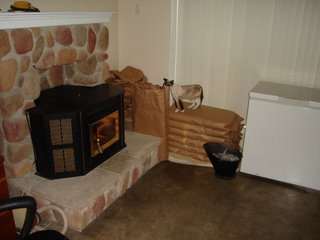
Casper inspects the corn. No mice found this time.
For more information about burning corn, visit: http://www.iburncorn.com/
John
I’ve chosen to supplement the heat from my natural gas furnace with heat from a corn-burning stove. I chose corn because it’s clean, and is easy to transport and store. Corn-burning stoves are efficient, safe, and easy to use. To determine how profitable heating with corn is, I carefully monitor my corn use, and compare natural gas heating costs to that of last year. Since the heating season is half over, I can now do the math.
All things considered, I’ve already saved $250.00. By the end of this heating season I will have saved $400.00 to $500.00, and I will have burned 3600 lbs of corn. The work involved in burning corn can be summarized as follows:
- Purchasing, transporting, and storing corn.
- Retrieving it and filling the stove’s hopper.
- Cleaning the stove and lighting the fires.
These tasks take no more than 15 minutes per 50 lb bag of corn, or a total of 18 hours for the entire heating season. If I were paying myself to do these chores using the money I’m saving by burning corn, I would have earned almost $28.00 per hour. And, although the price of corn has gone up recently, I’ll maintain this hourly rate by streamlining my corn-handling chores.
These numbers may surprise some people. You don’t have to wait for the price of other home heating fuels to increase in order to save money. You can save money now, and probably save a great deal more in the future. My calculations were the result of substituting corn for natural gas, but your savings will be even greater if you’re currently using a more expensive heating fuel. Additionally, you’ll become more carbon-neutral by burning corn, which is beneficial to the planet. This is truly a win-win situation.

Casper inspects the corn. No mice found this time.
For more information about burning corn, visit: http://www.iburncorn.com/
John
Subscribe to:
Posts (Atom)