About twenty five years ago I was asked to use my electronics skills to develop a device that would not only improve the quality of life of a disabled person, but also to allow him to call for help in the event of an emergency. Over the years I’ve developed several different versions, each one being better than the previous one. The latest allows full control of a telephone, including a memory for up to twenty-four phone numbers, full control of a television and any other device that is normally operated via a remote-control unit, and off-on control of any AC-operated device. With an appropriate speakerphone the system is always functional, even in the event of a power failure. The control device is fully programmable by the disabled user, and all tasks are performed by using only two switches. For a quadriplegic who has no use of his hands, this level of functionality is necessary. A small tube placed close to the users face provides access to the switches. Short puffs into the tube activate the first switch, and a sipping action activates the second switch. The user scrolls through a menu of functions shown on a backlit LCD display by a series of puffs, and performs the selected action by a brief sip.
The user was my brother-in-law Mike, and unfortunately he passed away last week.
As tragic as Mike’s story is, he was blessed with a good family and friends. Each contributed to the improvement of the quality of Mike’s life in his or her own way, and I’m glad that I was able to do my part.
Because a quadriplegic relies on those around him for tasks that the rest of us take for granted, being able to do some of those things unassisted must have been a pleasure. That simple pleasure is what I hope to have brought to Mike’s life for the duration of his disability. Knowing that I had a positive impact on his daily life is my reward.
John
Wednesday, August 30, 2006


Friday, August 25, 2006
The Best Application of Solar Photovoltaic Technologies
Large-scale energy projects are wonderful in that they can claim to make substantial reductions in carbon emissions, and provide benefits to the owner or community served, but I find small-scale systems much more interesting. While huge arrays are impressive, they simply serve to replace grid-supplied power with power from the sun. I’m not terribly excited by this. On the other hand, small-scale solar photovoltaic (PV) projects provide practical solutions to a variety of problems. Ranchers, for example, use simple PV systems to pump water for cattle in areas where no power lines exist. While windmills were once used for this purpose, their tendency to breakdown makes PV systems a much more practical solution. The PV solution is elegantly simple in that no batteries, charge controllers, or inverters are required. The output of the PV array is connected directly to the pump. Pumps used in this application have been designed to withstand low-power conditions, resulting from of cloud cover for example, without damage.
Where power lines don’t exist, or where it is simply too expensive to run them, small PV systems are often the best power option. Remote cabins and vacation homes are an example. PV systems offer an alternative to noisy, smelly fuel-powered generators. While the initial cost of a PV system is greater than that of a generator, the cost of fuel to run the generator quickly surpasses the cost of a PV system. And, not having to haul fuel is a bonus.
The limitations of my own small off-grid photovoltaic system keep my interest high. Instead of having a system that automatically kicks-in in the event of a grid power failure, I scramble to run extension cords and lights. I monitor the drain on my system, and ration the power used for the duration of the outage so that I don’t run short. When grid-power fails, I’m the energy czar in my home. While I wish that my system were larger, there are advantages to living with these limitations. Members of my household are aware of the power that certain devices require. While we’ve taken electricity usage for granted in the past, now we tend to conserve. We understand the importance of buying energy-efficient appliances, and turning off lights and other devices when they’re not being used. We’ve learned about phantom loads, and we avoid them. Our goal is to keep enlarging our PV system and to keep reducing our electricity usage. Eventually, we'll be able to produce all that we need. This goal will take years to achieve, but then the journey is the interesting part.
Perhaps the most worthwhile PV systems are those installed in rural third-world country residences. Without PV, many rely on kerosene for lighting. This practice results in fires and injuries, as well as health problems resulting from breathing the fumes. While the initial cost of a system is relatively high considering the income of the recipient, the overall cost is lower than the cost of using kerosene. PV power is also used to run radio’s, TV’s, and computers in rural schools, as well as to provide power for refrigeration needed for medicine. Non-profit groups such as the Solar Electric Light Fund (SELF) install systems and provide financing. In addition, SELF establishes local dealerships and trains local residents as installers and technicians.
While the first practical application of solar panel technology was in the space program, it seems ironic that the most worthwhile use for this technology happens to be in the most underdeveloped areas on this planet. I wonder what the recipients of this technology think when they look at the charge controller. I wonder if they know that it not only protects the battery, but optimizes charging as well. Do they appreciate the effort that some engineer put into the design of this product?
It seems to me that providing PV technology to those who need it is a far better way to win hearts and minds than by occupying a country and killing its residents. As a solar PV system researcher I wish I were eligible for grants and subsidies. I can only imagine what I could do with one point four billion dollars, the cost of one week of war in Iraq. If I were president things would be different. While I’m waiting to be elected, I’ll welcome contributions large and small to finance my work. Anyone? Hello?
Solar John
Tuesday, August 22, 2006
Gloom and Doom
My research in alternative energy has turned up a lot of what I would call “gloom and doom” predictions. Some articles go as far as to predict widespread chaos, and a total collapse of the economy. I guess that some that are looking into alternative energy are doing so in order to protect themselves from a major energy infrastructure breakdown.
Since we’re already seeing gasoline prices rise at an alarming rate, it’s not hard to believe that these predictions have merit. Food will certainly be more expensive in the future due to processing and shipping costs. If this trend continues, we may eventually see only locally-grown items on the shelves.
It’s not hard to imagine gas prices so high that we only drive in emergency situations. High heating costs could force many of us to lower our thermostats and to wear warmer clothing indoors. A major increase in the cost of electricity might prompt us to cool our homes with fans instead of central air conditioning.
Shortages or costly electricity and heating oil need not be a problem for those who prepare in advance. For a modest investment you can generate enough electricity to exceed your basic needs via solar or wind power. It would be wise to consider alternative heating systems that eliminate your dependence upon natural gas pipelines or other utility-supplied energy. Learning to grow and preserve food could also prove to be a valuable skill.
Those who prepare in advance will not have to venture out for solutions in the event of a crisis. At that point, it’s too late anyway. The necessary items will probably not be available. In a serious crisis, those who don’t prepare will need to be rescued. If help comes at all, it will probably come from ordinary citizens, not the government. The aftermath of Hurricane Katrina should have taught us that. Meanwhile, some will become victims of looters and others desperate to help themselves. Those who don’t have to venture out are the ones most likely to survive. Those who live in the suburbs are more likely to survive than those who live in crowded areas where there will be a lot of competition for few resources.
We typically have food in our pantries, and some of us have emergency water and food stored away, but what do we do when these items run out? We’re sometimes told to keep a 72 hour supply, but we’ve seen that in some emergencies it has taken longer than that for help to arrive. In many cases, rescued survivors were dehydrated, exhausted, cold, and tired. This won’t happen, even in an emergency where help is slow to arrive, for those who’ve made self-reliant living their goal.
Those who incorporate elements of self-reliant living into their daily lives are not only better prepared to handle emergencies, they’re also saving money on their utilities everyday. Those who grow their own food are most likely getting more exercise than those who do not, and they’re certainly eating healthier food.
Surviving a long-term emergency requires skills that the average person does not possess, and advance preparations. Given the current state of the world, this is a good time to acquire those skills and the necessary equipment. Hopefully, with enlightened leadership, a crisis of major proportions will be avoided and they won't be needed.
Begin by assessing your basic needs, and then look into the most efficient ways to meet those needs. After satisfying your needs for water and food, next consider shelter, heating and cooling, and electrical power. Don’t skimp on your electrical system since it can help to preserve (refrigerate), and prepare (cook) food. You'll probably need to boil the water you'll use for drinking. Your system needs to be large enough to do these things as well as to provide lighting, air circulation, and to power a radio and other equipment. Test your systems once in awhile by simulating a failure of utility company supplied electricity and fuel. You might find that your emergency equipment can be used to reduce your household expenses, and to preserve natural resources such as coal and oil, a win-win situation.
When Technology Fails, a book by Matthew Stein, is a good source of information.
Solar John
Monday, July 31, 2006
My Solar Photovoltaic System. Past, Present, and Future.
My solar photovoltaic (PV) system started out small, and is periodically upgraded as funds become available. When power outages have compelled me to use the system I’ve been well pleased with its performance, but at the same time I’ve wished that it could do more. With that in mind, I’ll attempt to outline the past, present, and future capabilities of the system.
Initially, my system components included one solar panel, a charge controller, some gel-cell batteries, and a 600-watt modified sinewave inverter. With the appropriate wiring, panel mounting hardware, and miscellaneous items, the total cost of the system was about $600.00. The batteries were throw-a-ways that I got from the IT department where I work. They were not like new, but still had some life in them.
Using a couple of 75-watt light bulbs as a test load, I found that the battery bank would last for just a little over an hour. While the solar panel was capable of producing more than 400-watts of power on a sunny day, the fully-charged batteries were only able to deliver about 150-watts. Clearly, the battery-bank needed to be upgraded.
I replaced the gel-cell battery bank with two marine deep-cycle batteries. The rated capacity of these is 105ah each, for a total of 210ah. Using the 150-watt test load, the battery bank lasted eight hours. Battery capacity jumped from 150-watts to 1200-watts (150-watts times 8-hours). However, since my single solar panel can only produce about 400-watts of power on a sunny day, it will take three days to fully charge a depleted battery bank. Still, the capabilities are much greater than they were before the battery upgrade. I need not worry about running out of power when the load consists of low-power devices such as compact fluorescent (cf) lamps. The cost of the battery upgrade, including wiring, was about $150.00, and was well worth it.
A recent upgrade included another solar panel and two more marine deep cycle batteries. I now have 800-watts (per sunny day) of charging capacity, and the ability to store 2400-watts of power in the battery bank. The system is limited in that it will take three days to fully recharge a depleted battery bank, but I have an abundance of power. During a recent power outage, I ran several cf lights, fans, a radio, and a cell-phone battery charger. I even connected a TV for a short time. The drop in battery voltage by morning was hardly noticeable.
My next goal is to be able to power our small chest freezer in the event of an electrical grid failure. I’ve measured the power consumption of the freezer, and found that it uses about 0.76 Kilowatt hour per day. This is just slightly less than the total daily capacity of the two-panel array that I currently have. Without another system upgrade, I’ll have very little power left over for lights and other things. Still, running the freezer is better than watching food spoil. And, if you consider that my fully-charged battery bank will supply enough power to run the freezer for more than two days, I should be OK for the short term power outages that we typically experience.
The inverter that I’m currently using may not be able to handle the high motor-starting current of the freezer, so my next step will be to purchase a 1000-watt true sinewave inverter. I’ll also install another solar panel so that I won’t have to skimp on lights and other low-power devices in order to use the freezer. This upgrade will also allow me to use a small microwave oven, and other high-power devices for a short period of time. At this point I’ll have just over two thousand dollars invested. The performance of the system in an emergency will be well worth it.
In the event of an electrical grid power failure in the winter, I’ll want the ability to use the system to provide heat for my home. Having installed a corn-burning stove this summer, the PV system will provide electrical power to the stove’s blowers, and auger. To meet the requirements of the stove, I’ll add one or more solar panels, and two more batteries. I’ll measure the actual power requirements of the corn-burning stove on high and on low settings later this year. The only time I’ll need to conserve power is when cold weather forces me to use the stove for an extended period of time. At all other times I’ll have plenty of power for lights and small appliances.
If I had been thinking only in terms of emergency heat I would have opted for something other than a corn-burning stove. I could have installed a wood-burning stove which could have heated my entire home without any electrical power requirements. However, wood burning is more work, dirtier, and not as safe as burning corn. My previously stated goal is to live comfortably in the event of an extended power failure. All of the chores that go along with wood-burning do not meet my definition of living comfortably.
For a little over $3,000.00 I’ll have a system that will meet all of my basic household electrical needs in the event of a grid power failure. Knowing that I could have opted for a generator for about a third of that, I have no regrets. While the initial cost of a generator would have been much less, the cost of fuel to run the generator would quickly surpass the cost of the PV system. And, fuel is not always available in an emergency. My power source, the sun, is free. It recharges the battery bank each sunny day.
Having met my emergency electrical needs, I’ll next focus on upgrades that will help to reduce my grid-powered electrical load on an everyday basis. I already use the system to provide power to my grow-lights for my plants, but it would be a shame to use the system for that alone. I want to replace grid-supplied power with solar-generated power as much as possible. I’ll run the chest freezer on a continuous basis and add wiring to my computer desk. I’m also considering the replacement of our refrigerator with a highly efficient Sun Frost model. I’ll add that to the solar-powered load. With periodic upgrades, I hope to power my entire house eventually.
I like the fact that my electrical and heating systems help to reduce carbon emissions, a leading cause of global warming. Someday, everyone will have to do their part in this effort. If voluntary efforts fail to produce the desired results, conservation will become mandatory, or perhaps electricity will become so expensive that grid-connected consumers are forced to cut back. Either way, I’m glad I have a head-start.
SolarJohn
Friday, July 21, 2006
Renewable Energy to the Rescue (Again)
On April 4th a tornado ripped through my neighborhood resulting in widespread damage, and a prolonged power outage. This event provided me with my first opportunity to put my small-scale photovoltaic (PV) system to practical use. On July 19th, my area was hit with another severe storm, and another extended power outage.
Prior to the latest storm, I prepared an emergency kit. This kit includes three light fixtures with compact fluorescent (cf) bulbs installed, extension cords, power strips, and a radio. When the power goes out, I run the cords to three areas of the house, and connect the light fixtures. Because cf bulbs use so little power, I don’t worry about the drain on the system if the lights are left on.
This most recent power outage occurred during a heat wave. Since our central air conditioning was unavailable, I connected a couple of fans to the PV system. To keep track of the storms progress, I also connected a radio.
Because our telephone service is provided by the cable company, a power outage results in a loss of service. Fortunately, our cell phones continued to work, and the solar PV system provided power to keep their batteries charged.
I tried to use a microwave oven with the system, but the inverter couldn’t handle the power that it requires. It tripped the breaker. I’ll make a note to myself to get a more powerful inverter as funds become available.
Had the power outage lasted longer, I would have connected our chest freezer to the solar PV system. The energy-efficient chest freezer would have prevented frozen food from spoiling, and I could have made ice to use in a cooler in order to protect perishables from our refrigerator. To keep things humming along in the event of an extended power failure, I'll need one or two more solar panels. I've calculated that my battery bank will keep things running for at least 24 hours, but the additional solar panels are needed to keep the batteries fully charged.
My system doesn’t do everything that I want it to do at the present time, but still it is extremely useful. While most of my neighbors have only candlelight or flashlights, we have plenty of light. We have a source of power for a radio, and I’ve even connected a small TV. We can keep somewhat cool with fans, and can keep our cell-phone batteries charged. Our power source is quiet, and inexpensive to operate. One of my neighbors has a noisy, gas-guzzling generator. I wonder how much it cost him to run that now that gas prices are so high.
Eventually, I’ll have enough power to handle the electrical requirements of our corn-burning stove. This will serve as our emergency heating system in the event of a winter weather power outage. Meanwhile, it’s good to observe that when a power outage occurs, life remains fairly normal in our home.
John
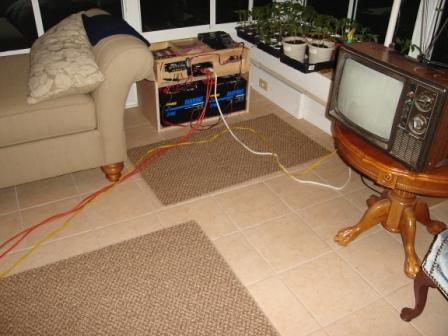
Shown here are my batteries and control electronics.

Extension cords and sockets bring light to other parts of my home.
Wednesday, July 19, 2006
Automating Solar PV System Performance Tracking
After installing my small solar photovoltaic (PV) system, I found myself constantly monitoring array and battery voltages, and performing tests to assess the capabilities of the system. A typical test involves monitoring a voltage over a long period of time. As an example, I might want to know how long a given battery bank will last when connected to a known load. To perform this simple test a voltage reading must be taken every few minutes over a period of several hours. A notation is made when the battery bank voltage falls below a predetermined value. This is just too time-consuming. To automate this task, I purchased a Data Logger.
The range of the Lascar Voltage USB Data Logger is 0 to 32 volts dc, making it ideal for measuring array and battery voltage. Software furnished with the data logger allows the user to set up logging rate, ranging from one reading per second to one reading every 12 hours. Typically, I use the one minute sample rate.
Another handy feature of the Lascar Data Logger is the option to set the start time. I often want voltage readings to begin just before daylight, but I don’t want to wake up early in the morning to start the data logger. I program the data logger the day before, and connect it to the voltage source to be measured. The data logger remains idle until the preset date and time, and then begins measuring voltage at the preprogrammed sample rate.
The software supplied with the data logger runs under Windows 98, 2000 and XP. Software installation is easy, and it’s hard to imagine how the software could be easier to use. After connecting the data logger to a USB port, simply run the software and answer the prompts. You only need to enter a file name for the current test, upload date and time information, start time, and sample rate. Then, remove the data logger from the computer’s USB port and connect its alligator clips to the voltage source to be sampled. A flashing green light tells you that all-is-well. As it takes each voltage reading, the data logger creates a txt file. This is a type of file that can be viewed with any word processing program, or with a text editor, such as Microsoft’s WordPad program. The software also creates a printable graph from the data.
By maintaining a log of battery bank data, I now have a baseline with which to compare performance in the future. Using this information, I’ll know when it’s time to replace my battery bank. In the same way, analyzing PV array voltage over time can alert me to solar panel problems.
Measuring voltage is helpful, but it is also important to know how much power is being supplied by the array or the battery bank. Measuring power with the data logger is not as straightforward as measuring voltage, but it is possible. The first step is to add a resistor in series with the array or battery wiring. This must be a low-resistance, high-power resistor. Next, use the data logger to measure voltage across the resistor. Then, use Ohms Law to calculate current and power. In the example below, I used a one-tenth Ohm resistor, and I measured 1.2 volts across it.
First, calculate current: Current (I) = E/R or:
Voltage (E) = 1.2
Resistance (R) = 0.1
Current (I) = 1.2/0.1
Current (I) = 12 amperes
Then, calculate power: Power (P) = E times I or:
P = 1.2 times 12
P = 14.4 watts
Note: This is the amount of power dissipated by the resistor, not the power that the array produces.
Caution: Batteries and solar panels are capable of supplying a tremendous amount of power. Choose a resistor of sufficient wattage so that it will not heat up excessively. If in doubt, don’t perform these tests unattended. A fire could result.
Shown below are samples from a logging session. The left-most column is the sample number, beginning with the first sample. Next, the date and time are recorded, followed by the PV array voltage reading for that date and time. Notice that as the sun rose, the voltage readings increased. To avoid a long blog entry, I’ve only shown the first hour of here. Notice that the voltage rose sharply at 5:21:01.
1, 05/06/2006 05:00:01, 0.05
2, 05/06/2006 05:01:01, 0.05
3, 05/06/2006 05:02:01, 0.10
4, 05/06/2006 05:03:01, 0.15
5, 05/06/2006 05:04:01, 0.20
6, 05/06/2006 05:05:01, 0.30
7, 05/06/2006 05:06:01, 0.40
8, 05/06/2006 05:07:01, 0.50
9, 05/06/2006 05:08:01, 0.65
10, 05/06/2006 05:09:01, 0.80
11, 05/06/2006 05:10:01, 1.00
12, 05/06/2006 05:11:01, 1.25
13, 05/06/2006 05:12:01, 1.55
14, 05/06/2006 05:13:01, 1.85
15, 05/06/2006 05:14:01, 2.15
16, 05/06/2006 05:15:01, 2.50
17, 05/06/2006 05:16:01, 2.85
18, 05/06/2006 05:17:01, 3.25
19, 05/06/2006 05:18:01, 3.70
20, 05/06/2006 05:19:01, 4.25
21, 05/06/2006 05:20:01, 4.80
22, 05/06/2006 05:21:01, 12.50
23, 05/06/2006 05:22:01, 12.50
24, 05/06/2006 05:23:01, 12.50
25, 05/06/2006 05:24:01, 12.50
26, 05/06/2006 05:25:01, 12.50
27, 05/06/2006 05:26:01, 12.50
28, 05/06/2006 05:27:01, 12.50
29, 05/06/2006 05:28:01, 12.50
30, 05/06/2006 05:29:01, 12.50
31, 05/06/2006 05:30:01, 12.50
32, 05/06/2006 05:31:01, 12.50
33, 05/06/2006 05:32:01, 12.50
34, 05/06/2006 05:33:01, 12.50
35, 05/06/2006 05:34:01, 12.50
36, 05/06/2006 05:35:01, 12.50
37, 05/06/2006 05:36:01, 12.50
38, 05/06/2006 05:37:01, 12.50
39, 05/06/2006 05:38:01, 12.50
40, 05/06/2006 05:39:01, 12.50
41, 05/06/2006 05:40:01, 12.50
42, 05/06/2006 05:41:01, 12.50
43, 05/06/2006 05:42:01, 12.50
44, 05/06/2006 05:43:01, 12.50
45, 05/06/2006 05:44:01, 12.50
46, 05/06/2006 05:45:01, 12.50
47, 05/06/2006 05:46:01, 12.50
48, 05/06/2006 05:47:01, 12.50
49, 05/06/2006 05:48:01, 12.50
50, 05/06/2006 05:49:01, 12.50
51, 05/06/2006 05:50:01, 12.50
52, 05/06/2006 05:51:01, 12.50
53, 05/06/2006 05:52:01, 12.50
54, 05/06/2006 05:53:01, 12.50
55, 05/06/2006 05:54:01, 12.50
56, 05/06/2006 05:55:01, 12.50
57, 05/06/2006 05:56:01, 12.50
58, 05/06/2006 05:57:01, 12.50
59, 05/06/2006 05:58:01, 12.50
60, 05/06/2006 05:59:01, 12.50
Details from this session:
5:00:01 (am) Begin logging voltage at sunrise.
5:21:01 (am) Voltage sharply rises to about 12.5 volts just after sunrise.
Additional details from this session, but not part of the raw data shown above:
5:30 to 11:00 Power from the PV array tops off the battery charge.
11:00 Charge Controller senses a fully charged battery bank and reduces
charging current. Because the load on the PV array is reduced, PV
array voltage rises.
11:00 to 16:30 Clouds and shadows cause voltage fluctuations.
16:30 As the sun sets, PV array voltage drops.
20:30 PV array voltage drops to zero at dusk.
This data not only shows me that the PV array is producing power, but also that the Charge Controller is working properly. This is good to know. A faulty Charge Controller might damage the batteries, or cause them to produce a dangerous amount of hydrogen gas. Fortunately, I have an option to set alarms when programming the data logger. If the alarm feature is used, the data logger produces an audible signal when a preset low or high voltage set point is reached. By responding to the alarm, I can prevent further damage to the equipment, and avoid a buildup of hydrogen gas.
It would be better to monitor PV array and battery bank voltage simultaneously, but that would require a more expensive data logger. I’m pleased with the performance of my single-channel data logger. Over time, I’m compiling a useful log of system performance data. Since the amount of sunlight varies from day to day and season to season, each logging period produces different results. The load on my battery bank also varies over time, and logging voltage over time is the only meaningful way to monitor battery condition and performance. All things considered, the data logger was a very worthwhile investment.
Solar John
Subscribe to:
Posts (Atom)